
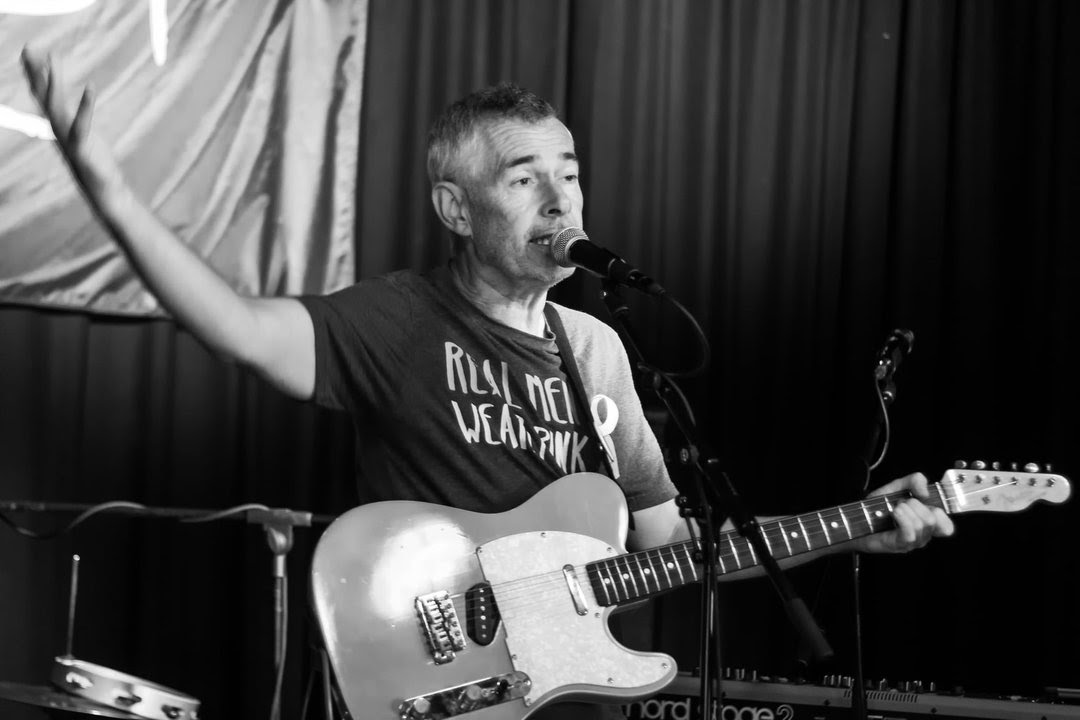
European Sun is a Bristol-based indie pop project led by songwriter Steve Miles, best known for his work with The Short Stories. He also writes an occasional guest column for PennyBlack Music. The band brings together Miles with cult indie figures Amelia Fletcher and Rob Pursey, known for their work in groups such as Talulah Gosh, Heavenly and The Catenary Wires and includes drummer Ian Button. Formed out of a long-distance but creatively natural collaboration, European Sun blends Miles’ songwriting with Fletcher and Pursey’s production, arrangements, and multi-instrumental performances. Their sound grows out of the quieter, more reflective direction Miles pursued after stepping back from the fuller-band ambitions of The Short Stories. Their debut single, The Future’s Female sets the tone for the project: sharp, witty, and politically engaged. Through a series of personal and social vignettes, the song critiques toxic masculinity, nationalism, and intolerance, while ultimately offering a hopeful message that the future lies in more compassionate, progressive values. European Sun’s music balances seriousness with humor, aiming to respond thoughtfully to the cultural and political climate of the post-Brexit era. The eponymous debut album (out in 2020 on Wiaiwya) continues this approach, combining melodic indie pop with socially conscious storytelling. Miles’ second album under the European Sun name, When Britain Was Great (out now via Skep Wax Records and featuring Elin Miles as additional vocals) expands this vision, through songs that combine political critique, personal vulnerability and playful, genre-spanning indie pop, delivering a pointed yet melodic rejection of “masculine energy” culture, of nostalgia for an imagined past where men were men, and racism was de rigeur, of fetishisation of a World War by patriots who are too pumped up to realise the war was a fight against Nazism.
Because Steve Miles is not only a musician, but also a keen observer and an elegant storyteller and, certainly, an original and distinctive person, his Mixtape is composed of many words and a single song!
“The single eviscerates nostalgia for an imagined past where men were men, and racism was de rigeur.”
| School Report is an epic pop song with a disconcertingly funny lyric about the cruelties of the past echoing into the present. The singer relates the story of a day where the tiniest efforts at personal progress are held back by the character assassinations delivered to him, decades ago, by hostile teachers. It was released on December 30th 2025 as a digital download and as a stand-alone CD, complete with real school repor for free with copies of When Britain Was Great. |
“Falling Down The Stairs With Arthur Seaton is a garage-punk pop song about the way we try and fail, and then fail again to make headway against a system that’s so powerful, that we end up resorting to drink – and then try, and fail again, the following morning. (Arthur Seaton is the protagonist in the book/film ‘Saturday Night And Sunday Morning’).”
What Steve Miles says about the songs on When Britain Was Great:
“This record was made very differently to our debut album, which came out in 2020. For that record, I was recorded playing the songs on an acoustic guitar with my vocals and then Rob and Amelia from Heavenly added all the instrumentation and additional singing over the top. It was really fun to see how they interpreted the songs; we had some discussion about the arrangements but ultimately it was all their decisions and I was really happy with that because I didn’t have the time to commit to it, and because we live three and a half hours apart from each other, collaboration wasn’t really possible.
Buoyed by the excitement of playing gigs around the time of that record’s release, I went through a very creative phase and wrote another whole album’s worth of songs in 2020, which has finally seen the light as When Britain was Great. This time, we recorded the bass and drums first, and then I took that away and added everything else to it. I had to teach myself how to produce a record as I went along, and since I play everything else on it, it ended up taking four times as long to record it as to write it! Musically, I’m really pleased with the palette of sounds, which is different from the first album – strings, horns, piano, etc – and obviously me on electric guitars. Several of the songs ended up without some of the rhythm section (ironically, the one with no bass at all is our bassist’s favourite track now!) and one song, When I have Fears, had a lot of remixing of what was already there, to make the song dubbier and about twice as long as the initial recording, allowing me to recite a poem by Keats in the second half and offer a feeble tribute to the reggae artists I admire.
So the songs on this album were all written actually about five or six years ago, which is easy to spot once you know it. If you think back to the period 2020-2021, it was the time of the Covid restrictions and upheaval, and also George Floyd’s murder and Black Lives Matter in America and their counterpoint in Britain which included the toppling of the statue of Edward Colston, a prominent slave trader who’s celebrated all across my hometown of Bristol. All those things get mentioned on the album (explicitly in the song Edward Colston’s Likeness) but, rather sadly, they’re no less resonant now than they were then. Falling Down The Stairs With Arthur Seaton directly references George Floyd’s murder and the general sense of being let down by government that was pervasive then.
At that time, Trump was in the end of his first period of office, Boris Johnson was Prime Minister of Britain, Elon Musk was already flexing his muscles, and I think that whole Covid period was when social media really came into its own. The first two songs on the record, Choice Paralysis and Going Viral, both deal with the connections between social media and our political situation, the difficulty of separating out the good from the bad, the opportunities from the costs.
Other songs on the record, like The Angels in the Clouds and In Bedford Falls, deal with the relationship of the past to the present, because if you’re looking at MAGA and Black Lives Matter, or at the patriotic nationalist right’s rhetoric in Britain and Europe, you’ll see that time and again they weave their narratives of a better future (with them in charge) on the back of the myth of a past that was somehow better than the present and which has been lost. That became the central theme of the record – including the title track, of course, which is probably the second-best lyric I have written.
I subscribe completely to the notion that ‘the personal is political’ and so all of those songs – and others, like Their Ncuti Gatwa Poster – explore the intersections between our private lives and the political and social frameworks that shape them (gender roles, race, and the patriarchy). I think that ‘Who am I?’ is a political question, and everything we do and say is a political act. If you write a song and you don’t sing about what’s right and what’s wrong, you’re just leaving the field to the powerful, and that’s not going to end well. And so there are a number of songs on the record which deal with the relationship between ordinary people and the extremely powerful, extremely wealthy psychopaths who have risen to ascendancy during this time. I know I’m just a tiny fly in their billion-dollar ointment, but it’s the thought that counts.
When I have Fears isn’t one of my better lyrics, but I was trying to express the feeling that a lot of kind people have at the moment which is sheer exhaustion at the feeling of waking every day to some even more monstrous statement or action from these bad people; Keats’ poem is one I have always loved and it’s there to offer some sort of consolation – albeit that ‘all things pass’ isn’t much use if you’re being shot at by ICE or trolled by JK Rowling. The two songs that might not seem so political, Dad and The Space She Left, actually have much in common. They are both about people I loved and who I lost. I hope that by demonstrating the ability to be ‘vulnerable’ as a cisgender man, it might help other people open up more, which is always a good thing. I firmly believe that emotional honesty is something that threatens the powers-that-be even more than organised radicalism – because empathy fights fascism better than bombs. It seems significant to me that those two songs reflect on events of many decades ago but feel as raw as if they happened last week, but that wasn’t by design: my inner life, as chronicled (and gently mocked) in School Report pretty much works that way. It’s for all those reasons, just as much as the ironic link to the far right’s attempt to hijack the St George’s Cross as their own, that we had to have a picture of me as a little boy on the cover.
His “Mixtape”:
Michael Shelley – Mixtape
“For my mixtape I’ll pick just one song. It’s Mixtape by Michael Shelley. He released four albums of absolutely top-notch pop under his own name and one more with noted Scottish drummer and songwriter Francis MacDonald. I love them all. His records are a lot more polished and pleasant to listen to than most of the music I normally like, but his lyrics are so sincere and open and witty, and his melodies so catchy, that it’s impossible not to really warm to. Mixtape is the perfect ode to the concept of a mixtape, so it couldn’t be more fitting.
When Britain Was Great is out now Skep Wax Records. Look HERE for more information on European Sun.
 Indie Sunset in Rome