
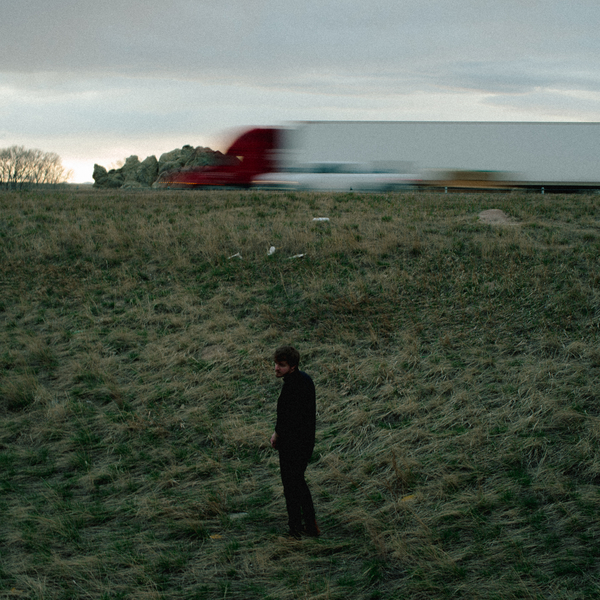
Francesco Amoroso per TRISTE©
With his third album under his own name, Nightmare World I See The Horizon, Logan Farmer deepens the sense of quiet collapse that has long defined his work, expanding the intimate desolation of Still No Mother and A Mold For The Bell into something broader, more accusatory. If earlier releases asked how one might endure a world in decline, Nightmare World I See The Horizon poses a more unsettling question: how does one live with oneself while watching that decline unfold, comfortably and complicitly? The focus shifts toward the origins of ruin and our (as humans) uneasy role in sustaining it. Farmer’s songwriting still moves with a hushed, deliberate pace, rooted in fragile acoustic textures and spectral atmospheres, but the emotional register has subtly changed. The sorrow and dread remain, yet they are now threaded with a sense of shame. The result is a work that feels less like witnessing catastrophe and more like inhabiting it. There is a heightened self-awareness in both the lyrics and the arrangements, as though each sound has been carefully weighed. Building on the stark intimacy of A Mold For The Bell, which transformed everyday impressions into something ominous and reflective, Farmer now embraces a wider sonic palette. Elements of slowcore and Americana emerge giving the record a raw, spacious quality. The collaborations, subtle yet vital, add depth without disrupting the album’s core restraint. These textures frame a series of songs that drift between the personal and the collective, where environmental collapse, violence, and digital numbness blur into a single, continuous horizon. It is a stark, contemplative record: unflinching, immersive, and quietly devastating.
Inside Nightmare World I See The Horizon, track-by-track (by Logan Farmer)
1. The Hunt
This song is about my (occasionally toxic) relationship with songwriting and the music industry, reimagined as a kind of fable. I fancied myself some kind of medieval maiden, wringing her hands and hoping to escape the doldrums of domestic life.
I started releasing my own music when I was about 15 as a way to process the world around me. Now, almost 20 years later, songwriting has become so closely intertwined with my identity and feelings of self-worth that it’s become difficult to understand my place in the world without it. If the well runs dry one day, who will I be? If there was no one to listen, would I still sing? I spent a lot of time asking myself these questions when composing the songs, and I really took my time with the lyrics to make sure I was never phoning it in or writing just because “that’s what I do”. The Hunt is about all of these things.
2. Famously Dead
This was one of the first songs that I wrote for the album, and it served as a kind of north star when setting the tone and narrative direction of the other songs. Like much of Nightmare World, it’s about the close proximity of comfort and violence in modern American life, and the feelings of complicity that come from that.
3. String of Pearls
Another song about the constant exposure to violence intertwined with unprecedented comfort in the digital age. Feelings of violation and ruin. This song always sounds a bit villainous to me, and it was fun to play the guitar with a more flamenco-esque finger-picking style.
4. The Guard
This song is about fantasy, dreams, and childlike wonder in times of conflict. I imagined a kid alone in some wartorn country, huddled in the wreckage of a bombed-out apartment building, dreaming of escape. It was largely inspired by the genocide in Gaza and the novel Hurricane Season by Fernanda Melchor. Heather Woods Broderick sang with me and played cello. She’s one of my absolute favorite singer-songwriters working today, so it was a joy to collaborate.
5. Boxcar
This song is about how we fill our days with small luxuries and distracting hobbies (model trains, in this case) while civilization slowly crumbles outside our door. Sonically, the song is a bit inspired by Springsteen’s State Trooper, and I tried to inject it with just as much urgency and panic to belie the seemingly domestic nature of the lyrics.
6. Manhattan
For lack of a better phrase, Manhattan is a love song for the end of the world. I had been listening to a lot of Americana and wanted to try my hand at writing something very direct that didn’t shy away from how I had been feeling. No poetics or metaphor. The line ‘They’re dropping cans of tear gas on survivors, I’m tossing cans of beer to land upon the kitchen floor’ came to me one day, and the rest followed pretty quickly. It’s again about those feelings of complicity, about aging, and trying to sustain a normal life in terrifying times. It’s also the first time I’ve used pedal steel in a song (performed by Patrick Lyons) and it even has an honest-to-god electric guitar solo at the end (performed by Zachary Visconti). Despite the heavy subject matter, it still feels like a bright spot in the album. A breath of fresh air for the halfway point.
7. Jetplane
This song comes from the Luddite in me. Jetplane is about the trajectory of human progress and how it hasn’t trended towards a better or more equitable world, but rather the opposite. Heather Broderick also sang and performed cello on this one.
8. Iron with Iron
This song is about gun violence in the United States. It’s spoken through the voice of a child who witnessed a school shooting. This is the climax of the album. Sonically, it was a bit inspired by Mark Lanegan’s Strange Religion, which is one of my favorite songs.
9. The Lighthouse
This is another exploration of my relationship with songwriting and the music industry. It’s meant to serve as a complement to The Hunt. It’s very long and atmospheric, which I like for a final song. The house has burned down, and we linger on the shore. The line “I swear that I saw the shape of an eagle pass above the telephone wire” is a nod to both Leonard Cohen’s The Story of Isaac and Conor Oberst’s Eagle on a Pole.
Nightmare World I See The Horizon is out now via Western Vinyl. Look HERE for more information on Logan Farmer.
 Indie Sunset in Rome