
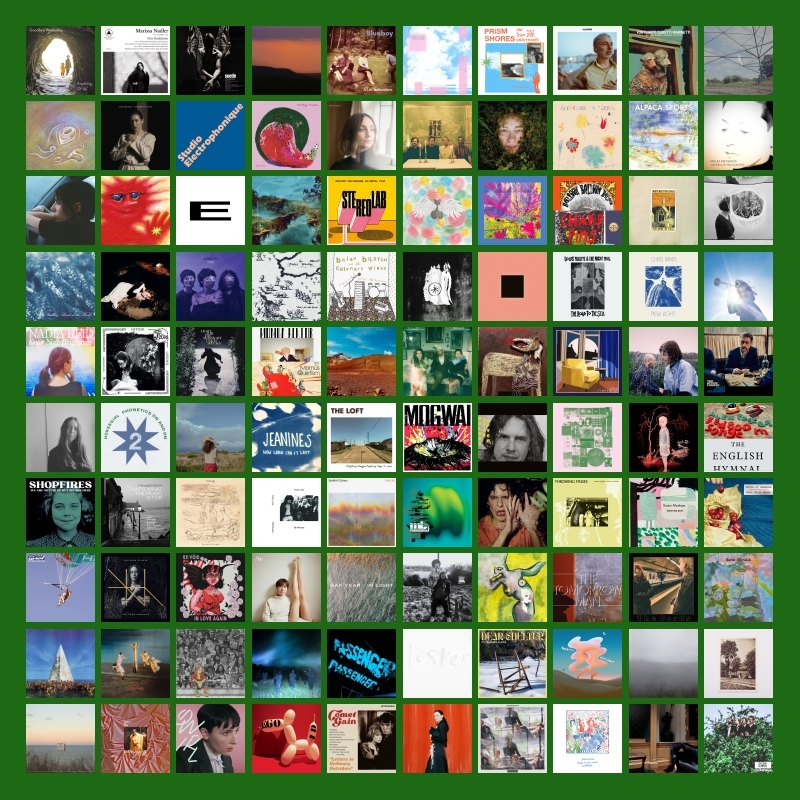
There’s something fundamentally wrong about year-end lists. Not because music isn’t worth celebrating, but because trying to pin down twelve months of listening into a tidy hierarchy of numbers is, at best, an exercise in personal mythology and, at worst, a meaningless ritual we repeat out of habit. Albums don’t exist to be ranked, art doesn’t ask to be quantified, and the emotional weight of a record rarely has anything to do with its position on a list.
And yet, despite all of this (or maybe because of it) I keep coming back to them.
If I’ve been deeply skeptical for years about the usefulness and meaning of compiling those infamous year-end rankings, I’m even more so this time around about the point of publishing them in the second half of February. We’re all already focused on the future (and thankfully so, since we usually spend far too much time staring back with our wide, nostalgic eyes), and in the first month and a half of 2026, a dozen or so albums have already been released that, I’m willing to bet, will end up in my year-end top 100 (which, perhaps, will be published in March 2027, assuming I ever find the courage to embark on a Herculean and ultimately futile undertaking like this one).
So, what’s the point? Well, I’ve done it now, and as usual I’m happy to share this list of my favorite albums of the past year with anyone willing to read it. This is, of course (though it’s always best to specify it every time), a list based purely on my own tastes and sensibilities, and it makes no claim to represent the best of what was released in the past year.
It also doesn’t include many albums that, while I truly appreciate them, I simply haven’t gotten around to exploring in depth, or that, while magnificent, arrived at the wrong time for me. I could easily make a separate list of at least fifty albums that fall into this category.
So take it for what it is: a list written with heart and passion, gathering some of the 2025 releases that sparked my passion and found their way into my heart. And, as always, if you end up discovering even a single album you missed (and, please, let me know), then all the time I’ve spent putting this together won’t have been wasted.
Happy listening, wherever you are.
01. Constant Follower – The Smile That You Send Returns To You (Last Night From Glasgow)
The songs of Constant Follower draw direct inspiration from the complex life experiences of their author, Stephen McAll, as well as from literature and the rugged, untamed landscapes of Scotland. Shaped by trauma, personal loss, and grief, his writing confronts these emotions honestly and fearlessly, yet always leaves room for hope. This, however, does not mean the music is merely introspective or self-referential. On this new album, the personal often expands into the universal, and McAll’s melancholic, almost resigned optimism becomes a quiet philosophical lesson: small kindnesses, and empathy toward others, may be the only antidote to despair and pain. The songs on The Smile That You Send Returns To You are defined by McAll’s deep, melodic voice (at times desolate, yet always warm and welcoming) always prominent in the mix, often enriched by ethereal, caressing female backing vocals. Around him, acoustic and electric guitars overlap and intertwine, while subtle synth flourishes add atmosphere and depth. Yet it is the album’s quiet sincerity that makes it truly sublime. It is particularly evident in Whole Be, chronicling the journey from alcohol abuse to sobriety; in Almost Time To Go, featuring Andrew “Kurd” Pankhurst’s acoustic guitar and Andy Aquarius’ harp and in All Is Well, where sharp guitars rise from a sea of electronic pulses. Patient Has Own Supply, with its sumptuous lap steel and ambitious arrangement, is deeply melancholic and absorbing, verging on slowcore, as are the following tracks, Happy Birthdays and Gentle Teaching, while the closing Only Silence leaves the album with a glimmering note of hope. Dan Duszynski’s co-production adds further charm and mystery, allowing the music to drift from folk into dreamlike territory, ultimately transcending genre altogether. An incredibly moving album, one that leaves the listener amazed and enraptured.
02. Lightning In A Twilight Hour – Colours Yet To Be Named (Elefant)
Bobby Wratten is certainly not an artist who puts himself on display. Private and self-effacing since the glory days of Sarah Records and his Field Mice, always preferring to let the music speak for him, he rarely reveals more than he considers strictly necessary (whether in his very rare interviews or through his songs). Colours Yet To Be Named, the third full-length album from Lightning In A Twilight Hour, feels like a record that breathes in the shadows, moving through an emotional space where nothing is ever fully graspable. It is an album that defies definition, explores new territories, embraces the unknown as its compass, and proves once again that experimentation remains the beating heart of the project. Wratten continues the path he began with the magnificent Overwintering, but here the direction feels even more uncertain, as if each song must slowly reveal itself, note by note, to both the listener and its composer. The result is elusive yet deeply poignant, suspended in a fragile balance between melody and bewilderment, built on a sonic palette capable of communicating emotion before words even arrive. Tracks like The No-sound of Falling Snow and Every Flame a Sunset show how rhythm, when it appears, seems to emerge more from texture, distortion and shards of it, than from any recognizable structure. Red Comet turns a techno impulse into a distant, flickering impression. Opaque Retreat, with Anne Mari Davies’s voice bending and readjusting to the music’s shifting shape, is a perfect example of Wratten’s ability to fuse delicacy and restlessness. Fortress and Addicere are among the album’s most intimate and intense moments, and when Beth Arzy’s voice appears on Folk Radio the horizon briefly clears. But only for an instant: nothing in Colours Yet To Be Named is immediate, and that is precisely what makes it precious. A work without a predetermined destination, elusive even as it strikes, evasive even as it moves. A record that remains mysterious, yet continues to resonate long after the final note.
03. Alan Sparhawk – With Trampled by Turtles (Sub Pop Records)
With White Roses, My God, Alan Sparhawk sought to drown his grief over the loss of Mimi Parker (his lifelong companion and one half of Low) in a surprising jumble of R&B and hip-hop influences, dub, trap rhythms, broken beats, and alienating vocal effects, almost as if he were trying to break out of himself. This time, he has chosen the exact opposite approach, returning to familiar sounds and surrounding himself with a band of longtime friends: Trampled by Turtles, fellow Duluth natives and standard-bearers of contemporary bluegrass. Because perhaps the only antidote to pain is feeling together, and carrying it together. With these new travelling companions, Sparhawk does what he has always done best: he sings and writes songs that grab you by the throat, warm and solemn, sincere and emotionally courageous. This is how tracks like Screaming Song, Stranger, Torn & In Ashes, and Don’t Take Your Light were born. Tracks in which Sparhawk finally manages to expose his excruciating pain without filters or restraint. There are also reinterpretations of two songs from White Roses, My God: a dreamy version of Get Still and the dramatic, choral folk of Heaven. Created through a direct and spontaneous approach and recorded in a single day, the album is a collaborative effort centered entirely on emotion and shared feeling. It is no coincidence that its highlight is the extraordinary Not Broken (“It’s not broken, I’m not angry”), featuring the intense, almost reconciled voice of Holly, Mimi and Alan’s daughter. When, in the closing moments, the voices of father and daughter intertwine, it is hard not to feel a lasting shiver and surrender to emotion. As long as Alan Sparhawk chooses to share his feelings with us, we will be there: lucky to listen, with broken hearts and tearful eyes.
04. Smith & Cohen – Half Life (Self Released)
In nearly thirty years of collaboration, Australians Karl Smith and Pete Cohen have continued to move through life’s seasons with the same quiet grace that has always shaped their music. From their days with Sodastream (a defining name in intimate, melancholic acoustic pop) to today, from Looks Like a Russian to Little By Little, the duo has learned to balance family, work, and creative urgency without ever losing their instinct for honest songwriting. They have always dared to sing from the soul, with disarming authenticity. With Half Life, however, Smith and Cohen mark a crucial moment in their artistic journey: finally leaving behind the Sodastream name is neither a sudden change of heart nor a resignation, but a natural step, an act of awareness from artists who have taken the time to look within. Half Life is an act of courage, suspended between past and present, an album that feels like a patient meditation on the passing of time, on aging, and on the fragile value of everyday things. The melancholy, the understatement, the mournful yet enveloping atmosphere, the double bass and light guitar that have long defined their sound are still here, but the music breathes more freely, becoming more spacious. Each song is a small echo chamber of real life: wasted time, regrets, responsibilities, pent-up feelings: Happy 40 is atypical and courageous, precisely because it addresses maturity with delicacy but without sugarcoating the truth; Fields of Green is a duet that manages to feel both nostalgic and forward-looking. Fewer collaborators, more silences, more space between notes: the album reflects a life in which music is no longer central, coexisting with everything else, yet still essential, a lifeline, a way to give meaning to what endures. Half Life invites listeners into a world where imperfection is acknowledged, where life is complicated but worth living, and where observation and reflection still blossom into songs of disarming beauty. A deeply sincere work, it neither tries to reinvent itself nor settles for compromise: it is a powerful declaration of identity and belonging, one that never needs to be shouted.
05. The Divine Comedy – Rainy Sunday Afternoon (Self Released)
Northern Irish gentleman Neil Hannon, after seemingly closing the first half of a truly glorious career with the anthology Charmed Life in 2022, inaugurates the second with a new studio album, Rainy Sunday Afternoon, a collection of miraculously inspired songs steeped in melancholy, shaped by his usual exquisite musical ingenuity and refined literary grace: another peak in the already extraordinary Divine Comedy saga. Far from the more ironic and theatrical atmospheres of the masterpiece Casanova or the recent Office Politics, this new work embraces a more intimate and universal sadness, carried by elegant orchestral arrangements and lyrical writing that confirms Hannon as a true contemporary classic. Recorded partly at the legendary Abbey Road Studios, the album sounds magnificent, wrapped in old-world attention to detail and supported by consistently superb songwriting. “The Last Time I Saw the Old Man”, dedicated to his late father, is a song of aching beauty, while tracks like “The Heart is a Lonely Hunter” and “Achilles” blend culture, introspection, and history. “The Man Who Turned Into a Chair” and “Down the Rabbit Hole” unfold like brief, inspired mini-musicals, while “I Want You” reveals a surprisingly romantic and vulnerable Hannon. Even the album’s most ironic forays (such as “Mar-a-Lago-by-Sea”, imagining a decrepit Trump, freshly released from prison, longing to listen to cheesy music in his kitsch residence) retain genuine emotional depth. Rainy Sunday Afternoon is an extraordinary musical meditation on the flow of time, identity, endings, and the tenderness of continuing to search for real connections: profound, poignant, and splendidly human.
06. The Gentle Spring – Looking Back At The World (Skep Wax Records)
The Gentle Spring is the new band formed by Michael Hiscock, bassist and founding member of The Field Mice (and if I have to explain who they are, you’re probably reading the wrong page). Having moved to Paris, and joined by new musical partners Emilie Guillaumot (vocals, keyboards) and Jeremie Orsel (guitar), Hiscock has created an exquisite work, driven by a clear sense of creative urgency. While it doesn’t quite replicate the sound of his former band, it will certainly earn a place in the hearts of die-hard indiepop fans. Looking Back At The World features all the genre’s hallmarks, but more than the crystalline guitars and delicate vocals, the clean production or the melodic grace, it’s the sincerity, sensitivity, and gentleness (as the name suggests) that define the ten magnificent tracks that make up this wonderful debut. These are songs built on simple chords, simple instruments, and simple (but truthful) lyrics: minimal overdubs, minimal percussion, subtle clicks and drum samples, with acoustic guitar and piano taking centre stage. With direct, essential melodies (meticulously written and exquisitely performed) the songs on Looking Back At The World never feel nostalgic or passé, but instead seem to exist outside the logic of time and fashion. Fresh, intimate, shadowy, and full of personality, they are sung mostly by Hiscock, though Guillaumot takes the lead on a few tracks, delivering some of the album’s most tender moments. With restrained, carefully measured arrangements that lean more toward acoustic folk than indie, The Gentle Spring’s debut is a fiercely melodic, poignant, intimate, album of understated beauty, one you can easily fall head over heels in love with (unless you have a heart of stone).
07. Starlight Assembly – There Will Be Fireworks
Starlight Assembly is a collaborative project bringing together Italian musician, producer, and sonic experimenter Matteo Uggeri with Dominic Appleton, the iconic vocalist of British band Breathless and a longtime collaborator of This Mortal Coil. Born out of a long-distance partnership, the project marks Appleton’s first significant work outside Breathless, where he also serves as lyricist. Their debut album, Starlight And Still Air (2021), assembled through remote exchanges, was a multifaceted work, blending electroacoustic experimentation with a strong pop sensibility through an unusual and skillful mix of genres. Released four years later, There Will Be Fireworks refines and expands the project’s aesthetic while preserving its complex rhythmic structures and lyrical depth. The album develops the layered sonic architecture crafted by Uggeri (once again supported by a wide circle of collaborators) and Appleton’s deeply melancholic voice and gift for melody, here further sometime enriched by the haunting guitars of Breathless’ Gary Mundy. What changes most is the overall atmosphere: darker, more crepuscular, and shaped by a clearer song-based format, only partially present on its predecessor. Appleton’s unmistakable and emotionally charged voice adapts effortlessly to every direction the music takes, drifting into dub-inflected detours (The Not Dead, built around a poem by Poet Laureate Simon Armitage), ambient temptations (Relief), and whirlwind electropop deconstructions (Friction). Rhythm remains crucial throughout: pulsating lines with tribal undertones (Time, Moth To The Flame), Bristolian downtempo cadences (This Desert), and intricate patterns (All the Love that Stands Beside Us) structure a hybrid collection of songs whose forms constantly shift, yet remain bound by a remarkably cohesive tone. There Will Be Fireworks does not simply confirm an already established formula: it sharpens it, expands it, and makes it more immediate, with stronger songcraft, a more coherent musical journey, and two artists clearly playing to each other’s strengths. There are fireworks, indeed. (thanks to Peppe Trotta)
08. Blueboy – A Life In Numbers (Popkiss)
It must be said: it took immense courage to Blueboy, after their founder, singer, and main songwriter passed away in 2007—taken far too soon—and with three of the most iconic and extraordinary indiepop albums already behind them, to return with a fourth record, twenty-seven years after the last. Blueboy clearly have courage in spades. Reformed in early 2024 around the voice of Gemma Malley and the guitar of Paul Stewart, and following two singles (One and Deux), the reborn Blueboy released A Life in Numbers, an album that, in their own words, consists of “thirteen stories that feature all of life: loss, regret, excitement, failure, the beginning of love, the end of love, and everything in between”. With track titles arranged in numerical sequence and a full 55 minutes of music, Blueboy’s fourth album proves more than worthy of a discography that includes genre-defining masterpieces such as If Wishes Were Horses and Unisex (not to mention The Bank of England). It’s hard to imagine higher praise. Rather than merely revisiting the past, the band moves effortlessly from shoegaze urgency to pastoral folk, with lyrics sung in both French and English, always unmistakably Blueboy, even if Gemma Malley’s (then Townley) voice now feels sharper and more dramatic. A Life in Numbers is so beautiful it becomes unsettling, almost brutal at times: a swirl of melancholy dreampop, guitars that can be both caressing and explosive and a pulsating, dynamic rhythm section. Who would have expected such a return, after twenty-seven years, and without Keith? Overflowing with inspiration and anchored by consistently strong songwriting, each track, restless yet soft, sounds powerful and delicate, refined and angry. In the end, A Life in Numbers doesn’t try to replace what was lost: it honours it, carries it forward, and turns it into something quietly triumphant. A return this moving feels less like nostalgia and more like grace.
09. Alex Pester – Bedroom Songs /The English Hymnal (Self Released)
With six albums already under his belt (including two magnificent ones in 2024 alone), twenty-four-year-old Alex Pester returns in 2025 with two new releases that highlight the breadth of his sound. Bedroom Songs, released in January, once again confirms his ability to write exquisite little gems somewhere between folk and baroque pop, guided by a supremely refined melodic sensibility. Entirely conceived and recorded in his bedroom, it feels like an emotional tribute to the golden years of English beat and pop, especially the ever-beloved Kinks. Whether it’s the psych-pop whispers of This Empty Town and No Reason Why, the Beatles-esque It Finally Happened, the lo-fi charm of Star of the Week and That’s Enough, or the simple yet irresistible Julie Christie, Bedroom Songs is languid and melancholic, sprinkled with snatches of dialogue straight out of early 1970s British television. Imbued with sparkling, delicate melodies, at times almost shy and naïve (Just a Fool (For Love), How Long?), at others more intricate and compelling (Billy Liar), or simply perfect (Another Love Song), the album is marked by rare harmonic purity and elegant songwriting. Once again, Alex Pester delivers half an hour of pure sonic rapture. At the opposite end of Pester’s broad spectrum is The English Hymnal, originally released in March under the pseudonym Rosenberg as Lessons, and then reissued in May. It is his most difficult and tormented work: an open-hearted confession, raw and unrestrained. This isn’t an album of sonic caresses, but a complex and challenging listen, made even more jagged by its lo-fi recording. Yet even here, Pester manages to channel sincere vulnerability and an overwhelming passion for life and music. Authentic to the point of brazenness, The English Hymnal becomes the soundtrack to disillusionment, surrender and despair. Two more albums in a single year, two more steps into the life and art of Alex Pester. Whether he is capturing joy or staring into darkness, he always manages to convey real emotion.
10. The Cords – The Cords (Skep Wax Records / Slumberland Records)
We could say that The Cords are an indie-pop duo made up of sisters Eva and Grace Tedeschi from Greenock, Scotland. Or, more simply, that The Cords are proof that hope for the new generation of music isn’t dead yet. Their debut album is a distillation of youthful energy and sheer zest for life, shaped into fast-paced melodic songs driven by guitar and drums (there isn’t even a bass guitar, when on stage). Eva and Grace were born in the new millennium, yet their musical roots lie in classic jangle-pop and late-20th-century punk-pop. And still, their debut album never feels derivative or uninspired: it captures the immediacy of their live sound while conveying the urgency behind the sisters’ songwritin. Short, punchy songs interspersed with more reflective, melancholic moments. Eva’s brilliant, crystalline guitar lines and vocals, along with Grace’s propulsive drumming (and her precise bass playing), give every track a sense of momentum and vitality, while the spare production only heightens their sincerity. The references to the past are countless and proudly worn, but it’s the melodies that hit instantly, reminding us that The Cords are a contemporary band firmly rooted in the present. It’s clear that Eva and Grace have these sounds in their blood (probably passed down through DNA more than through the records they were raised on), and they deliver them with honesty and conviction: songs that are simple yet wonderful, immediate yet infectious, carrying the spirit of past, present, and future all at once. If 2025 gave us The Cords, then perhaps we can still allow ourselves a little hope for what comes next.
11. Sophie Jamieson – I Still Want To Share (Bella Union)
It’s not always easy to listen to Sophie Jamieson’s songs. They don’t resemble most of what you might put on casually, because immersing yourself in them feels like diving (without oxygen) into someone else’s life and emotions. And if you dare to go deeper, beyond the surface, a chasm may open up before you: a chasm at the bottom of which you’ll find a mirror that reflects not only the artist, but yourself. It’s an intense, yet magnificent experience. Only once you find the courage to be honest with yourself can you truly face I Still Want To Share. The London artist’s second album, released a little over two years after her magnificent debut Choosing, explores love, desire, loss, and renewal, with the same emotional weight and nuance. Jamieson’s sumptuous, aching voice remains the album’s centre of gravity and needs no embellishment to cast its spell. Yet rather than stripping things back, I Still Want To Share is enriched (thanks to Guy Massey’s co-production) by string arrangements and distinctive instrumentation, without ever compromising the intimacy of Jamieson’s writing. Electric guitars and fingerpicking accompany courageous and profound songs such as the bold Vista or the delicate Time Pulls You Over Backwards. The measured use of strings (Camera, I Still Want To Share) and omnichord (How Do You Want To Be Loved?) makes the songs even more dramatic and overwhelming, while I’d Take You and I Don’t Want To Save sound vulnerable yet fiercely alive. It was never going to be easy to follow an album as beautiful and sincere as Choosing, but Sophie Jamieson (now fully in command of her inner voice) has done exactly that, delivering one of the most devastating, painful, and musically exhilarating records of recent years.
12. Brian Bilston and The Catenary Wires – Sounds Made By Humans (Skep Wax)
Born out of a collaboration between poet Brian Bilston and indie-pop veterans The Catenary Wires (Rob Pursey and Amelia Fletcher of (Heavenly, Talulah Gosh, and many other bands) Sounds Made By Humans is not a series of poems set to music: it is a collection of proper songs, where words and music are fully intertwined, complete with verses and choruses. Bilston’s poems already feel like pop songs: short, direct, witty, sometimes moving, sometimes sharp and political, but always concise and accessible. Pursey selected thirteen of Bilston’s poems and built melodies and arrangements around them. Sometimes the words are sung by Amelia or Rob. Sometimes they are spoken by Brian. Sometimes both things happen at once. What matters is the result: these are pop songs with gorgeous melodies, (naturally) fantastic lyrics, and unforgettable choruses. It hardly matters that they began life as poems: the music wraps around them and transforms them without ever drowning them out. And so these songs can make you laugh out loud, move you, or suddenly fill you with melancholy. They can also be biting and political (“And when I die / I will be the scattered ashes / that attach themselves to the lashes / and blind the eyes / of racists and fascists”) as pop songs should always be. One small masterpiece follows another: from Alexa, What Is There To Know About Love? to Every Song On The Radio Reminds Me Of You, from Might Have, Might Not Have (which would shine even in Heavenly’s catalogue) to To Do List, all the way to Compilation Cassette, a nostalgic ode to the tapes that soundtracked so many teenage afternoons a few generations ago (and which, inevitably, feels very dear to us). Apparently born from Bilston’s love for Heavenly, Sounds Made By Humans is probably the most perfect marriage of poetry and pop music we could have hoped for.
13. Faith Eliott – dryas (Lost Map)
Born in Minneapolis and living in Edinburgh, Faith Eliott released their debut EP, Insects, in 2016, followed by their first album, Impossible Bodies, in 2019. dryas, released on Lost Map Records, is a fascinating and whimsical work driven by narrative and world-building, depicting intuitive landscapes populated by hagfish, Pleistocene volcanoes, cursed memes, and apocryphal late-Renaissance monsters lurking in the aisles of Asda. Sonically, Eliott relies on a stripped-down, lyric-focused compositional approach that evolved during the recording process to incorporate orchestral elements alongside electronic textures and found sounds. Their songs are romantic and surreal: while in Snowglobe (described as “a song about the fear of great, destructive things that might happen, and the pain of great, destructive things that are already happening”) they quote T. S. Eliot, in the incredibly delicate An Ode of Unrequited Love from a Hagfish to a Giant Isopod (surely a contender for best song title of the year) they construct a sentimental narrative rooted in scientific observation, unfurling a ballad of longing so acute it feels like a splinter in the heart, yet still infused with gentle humour. dryas, named after an Arctic plant that thrived at the end of the last ice age, reflects on resilience, reassurance, and liberation through Eliott’s seraphic and soothing voice, resting over delicate guitar arpeggios. Rather than adopting a more classically oriented singer-songwriter approach, however, Eliott favours atmospheric and layered (but never redundant) soundscapes, which lend the album its sense of “glacial” timelessness. Even the simplest material, shaped by the hands of a skilled craftsperson, can result in surprising beauty.
14. The Reds, Pinks & Purples – The Past Is A Garden I Never Fed
If the past were truly a garden that Glenn Donaldson never fed, nurtured and tended, it would be hard to believe that today we’d have such a vast and consistently excellent catalog of songs, built in just seven years since the launch of his The Reds, Pinks and Purples project. For his debut on Fire Records, Donaldson had the opportunity to choose from over fifty tracks (already released on Bandcamp but never pressed on vinyl) always rigorously self-produced and recorded at home. The result is a collection of songs through which, once again, the San Francisco artist opens a window into his soul with grace, irony, and just the right amount of shyness: that of an artist who uses music to navigate the complexities of life. With song titles that feel like small poetic worlds of their own, forming a vivid and disenchanted set that captures the “spleen and ideal” of Generation X, The Past Is A Garden I Never Fed moves effortlessly between fuzz and jangly guitars, punchier rhythms than usual (My Toxic Friend), and Donaldson’s unmistakable voice, capable of chiseling immaculate pop melodies and unforgettable choruses. The world definitely still needs bands like this!
15. Sean Armstrong – Velvet Ever After ((Rehberge Records)
Sean Armstrong reportedly recorded his first song (about squirrels) at the age of five. And hasn’t stopped since. He now lives in Berlin with his longtime musical collaborator Rachel Taylor, aka Rocky Lorelei, with whom he founded Rehberge Records, a small label named after their favourite park. Together, they also play in Slipper (their 2024’s A Tiny Rose Made Out Of Clay is just magnificent). Armstrong’s first solo album for Rehberge, The Technical Times, was released in 2022, while Velvet Ever After arrived in 2025 (cassette and digital only). A former member of Spinning Coin, Armstrong delivers with Velvet Ever After a stunning record that straddles folk and experimentation, always hovering on the edge of melancholy but never tipping into despair. Blending folk intimacy with chamber-pop touches, the Berlin-based artist writes delicate, gemlike songs such as Sewed the Winter to the Wall, the poignant The Wilderness is a Part of You (its chords enriched by keyboards and warm vocals), and the exquisite Occupied Moon, where voice and piano carry a fragile melody. While a few passages lean into more syncopated rhythms, most of this wonderful album is indebted to artists like Nick Drake and Robert Wyatt. Armstrong’s minimalist approach, somewhere between lo-fi and sonic experimentation, makes the album’s ballads even more affecting, relying on pauses and silences as much as on his elegant guitar playing. Yet what truly sets Armstrong apart is his decision (shared with Rocky Lorelei’s solo work and their joint project Slipper) to exist not only outside the music industry, but almost outside time itself. Velvet Ever After feels like a sonic bubble, enveloping the listener and briefly shutting out the noise of the world, leaving them suspended in the beauty and warmth of its timeless sound.
16. Clara Mann – Rift (The state51 Conspiracy)
After two refined and moving EPs (Consolations, 2021, and Stay Open, 2022), the Bristol-based folk singer-songwriter makes her full-length debut with Rift. Raised in a small village in the South of France and surrounded by classical music, Mann (already, despite her young age, one of the most authentic and exciting folk artists of recent years) uses guitar, piano, measured arrangements, and a superb voice, at once caressing and lyrical, patient and confident, to transport the listener into an idyllic atmosphere suspended outside time. Influenced by figures such as Edith Piaf, Molly Drake, and Judee Sill, Mann rejects any nod to modernity or temptation to update her sound. With a sensitivity imbued with nostalgia and emotional immediacy, she conveys a candor that feels increasingly rare, and increasingly necessary. On this evocative debut, built on vivid and intimate songs that highlight her classical training and the crystalline beauty of her natural vibrato (every nuance of her voice is audible, and every line seems to carry its own emotional weight), Mann explores feelings shaped by lived experience. Even when moving through darker or more melancholic terrain, her music always leans toward hope. Rift ultimately reveals a remarkable mastery of songwriting, as well as a finely tuned sense of balance between sound and silence, drama and restraint, an equilibrium that only deepens the intensity of her compositions.
17. Iona Zajac – Bang (Self Released)
Bang, the debut album by Glaswegian singer-songwriter Iona Zajac, follows a promising EP and a busy touring schedule supporting The Pogues, Cassandra Jenkins, Mercury Rev, Arab Strap, and Lankum. After several years singing more traditional folk music in the duo Avocet, Zajac has dramatically expanded her sonic palette, delivering a debut that places her among the most exciting and vital artists around right now. On Bang, the Scottish musician transforms trauma and anger into music, reflecting on toxic relationships and domestic violence, without ever letting such heavy subject matter without ever sacrificing the record’s gripping intensity. The album is charged with tension, sometimes subtle, sometimes thunderous, making these songs both haunting and cathartic. Even the most restrained and seemingly calm passages conceal a dark, menacing undercurrent, while Zajac’s defiant, furious, wounded voice remains strikingly intimate and magnetic. Her ability to balance light and shadow allows the album to alternate raw, explicit songs like Bowls, Dilute, and Anton with more dreamlike, surreal passages, often shaped by direct, almost pop-like touches that briefly ease the pressure. Brimming with personality and sonically powerful, Bang weaves together intimate acoustic moments, bursts of rock dynamism and inspired melodic instincts. It’s not only a fantastic debut, but the first step in an artistic journey from a musician who clearly believes music should do more than merely entertain. A proud, magnificent, and important album.
18. Will Stratton – Points of Origin (Bella Union/ Ruination Record Co.)
The ten songs that make up Californian Will Stratton’s eighth album address, in one way or another, the theme of the California wildfires. In that sense, written between 2021 and 2022, the record feels almost prophetic. On Points of Origin, Stratton steps away from introspection and turns his gaze outward, focusing on the lives of others: the squalid yet fascinating worlds of truck drivers, surfers, fugitives, drunks, thieves, CIA agents, forest rangers, arsonists, lawyers, and painters, all forming a literary portrait of extraordinary beauty. Like a short story writer, Stratton enriches his songs with witty, perceptive observations on climate change, weaving catastrophic (and increasingly man-made) events into the everyday lives of the characters who populate his narrative universe. With his melodic, soothing voice always at the forefront, Stratton relies less on his wonderful fingerpicking this time around, allowing delicate piano lines and a finely balanced string ensemble to take center stage. The result is a work of almost otherworldly elegance, drifting gently between folk, country, and Sixties-style balladry, and striking for both its sonic sophistication and narrative depth. A must-have for fans of Nick Drake and American frontier literature.
19. Sister Ray Davies – Holy Island (Sonic Cathedral)
Sister Ray Davies’ debut single, “War Machine (The Purpose Of A System Is What It Does)”, was one of those tracks that hits instantly and refuses to leave your head. Their debut album Holy Island, however, goes even further: it’s astonishing. An American duo making a concept record about a small religious outpost off England’s northeast coast isn’t something you come across every day. The history of Lindisfarne becomes a framework for abstract emotions and ideas that, in a metaphorical way, reflect on the historical moment we are currently living through. With Sonic Cathedral behind it, quality is almost guaranteed, yet Holy Island still feels remarkably distinctive. Though rooted in shoegaze, its sound is vivid and sharply defined: these songs don’t dissolve into fog, but remain tangible and immediately memorable, helped by punchy rhythms and electronic textures that often take the lead. Hypnotic vocals, guitars and synths in constant dialogue, driving drums with hints of motorik momentum, bursts of female backing vocals, and unexpectedly strong choruses all contribute to making Holy Island one of the most captivating releases of 2025. Its melancholy and darkness frequently open into flashes of joy and delicate sweetness. Comparisons are hard to find (and “shoegaze” feels more like a convenient label than a real definition). Holy Island is a rare debut: reflective, personal, and courageous, yet melodic and full of verve. With such a strong debut and such a perfect name, the future looks very bright for Sister Ray Davies.
20. Modern Nature – The Heat Warps (Bella Union)
From infinity to a straight line: this seems to be the trajectory Jack Cooper has traced with his Modern Nature project, launched in 2019 and now four albums in. While No Fixed Point In Space (following the excellent How To Live and Island Of Noise) was his most daring and collaborative effort (featuring Julie Driscoll, Alex Ward of Spiritualized, and Chris Abrahams of The Necks) The Heat Warps marks the arrival of a proper band. Cooper is joined by drummer Jim Wallis, newcomer Tara Cunningham on guitar, and saxophonist Jeff Tobias (here on bass). Opener Pharaoh makes the new direction immediately clear: metronomic rhythms, guitars tinged with psychedelic blues, and vocal interplay steeped in unmistakable Sixties echoes. Then comes Radio, reflective and jazzy, with a chorus worthy of peak Neil Young. Glance is the perfect showcase for the sound Cooper had in mind for this new incarnation of Modern Nature: strikingly close to Television, with two guitars weaving tightly around the rhythm section. Source, closing side A, is one of 2025’s essential tracks. The lyrics are thrilling, the music equally inexorable: “Silent towns afloat on storms / With the colors slowly draining…” before a chorus that captures humanity teetering on the edge: “There’s me standing in the riot…” After a brief film-noir interlude like Jetty (with its nod to Zeppelin’s Stairway to Heaven hard to miss), Alpenglow arrives, recalling Wilco’s A Ghost Is Born: visionary folk and hypnotic memoirs that slip into a trance. Zoology feels almost Lennonian, or like a Perfect Day stripped of the city and returned to nature and childhood memory. Takeover goes even further, joining Source as one of the year’s must-hear songs: a universal love song shaped by troubled times, seasoned with guitars that weep and shimmer, as if Yo La Tengo were channeling the late Mark Hollis. The Heat Warps closes with Totality, a blend of gospel and post-rock. Class, elegance, depth: music that still feels necessary.
(thanks to Matteo Maioli)
21. Throwing Muses – Moonlight Concessions (Fire Records)
Though it is Throwing Muses’ eleventh album, Moonlight Concessions still surprises with its originality. It moves away from the harsh, dark tones of recent releases, built instead around acoustic guitars and cello, forming an ideal bridge between the band’s sound and Kristin Hersh’s solo work. Songs like “Theremini” and “Libretto” show how unmistakably the band remains itself even when wearing different sonic guises, while “Drugstore Drastic” and “Summer of Love” lean closer to familiar territory. Hersh’s raw, angular songwriting is here supported by subtle, compelling arrangements that give weight to songs that are mostly acoustic and direct, yet consistently unpredictable. Moonlight Concessions unfolds through minimal narratives that celebrate everyday poetry: from existential conversations in the backseat of a car (“South Coast”) to being stuck in an Uber somewhere in California (“Albatross”), from the homeless man outside a beauty shop (“Sally’s Beauty”) to an overheard exchange between two men staggering down the street (“Drugstore Drastic”). The result feels like an existential manifesto. Another magnificent chapter in an extraordinary career.
22. Louis Philippe & The Night Mail – The Road to the Sea (Tapete)
Five full years have passed since the excellent Thunderclouds, and Louis Philippe’s return with his partner band, The Night Mail, The Road to the Sea, is another gem of refined craftsmanship, further proof of the extraordinary songwriting and arranging skills of the eclectic Philippe (sports journalist, chef, and recent philosophy graduate). Fourteen elegant and graceful songs, blessed with timeless melodies, suffused with a subtle veil of melancholy and echoing Bacharach’s orchestrations and the Beach Boys’ vocal harmonies. It is charming baroque pop, light on its feet, touched by jazz and lounge influences. Backed by musicians with whom his musical chemistry is increasingly evident, Louis Philippe has this time placed particular emphasis on pure songwriting, and the results are not merely pop songs but miniature sonic pearls (so much so that one begins to wonder whether, among the French artist’s many activities, his work as an oyster should be counted as well). Even after a forty-year career, remarkably few seem to have realized what an extraordinary artist they have in front of them, but Louis Philippe doesn’t seem to care, and continues undaunted along his path of honeyed notes.
23. Nation of Language – Dance Called Memory ( Sub Pop Records)
Nation of Language’s fourth album is also their first for Sub Pop Records, but the change of label doesn’t bring any major upheavals. The return of Nick Millhiser (formerly of Holy Ghost!, one of the key names of DFA Records’ first glorious era) at the helm ensures full stylistic and conceptual continuity between Dance Called Memory and its predecessor, Strange Disciple (2023). With this record, the Brooklyn trio deliver their most mature and intense work to date: an album that dances between melancholy and hope, between memory and renewal. Their music remains intimate, often rarefied and meditative, yet always alive and vibrant. What holds it together is a sequence of songs that are sometimes romantic, sometimes dreamlike, often charged with a visual, almost cinematic intensity, built on an electronic palette of undeniable magnetism. Imagine Kraftwerk grappling with a Slowdive remix album, or the best of The xx produced by Brian Eno. For convenience, we could call it dream (synth) pop, and identify I’m Not Ready for the Change as its perfect manifesto: a song in which dance, as the title of the album suggests, moves from the heart of the dancefloor to the center of the mind, amidst memories, fantasies, and delicate poetic vertigo. At first listen it feels unexpected, bordering on My Bloody Valentine territory, yet it remains unmistakably theirs, and no less seductive for it. Dance Called Memory is, ultimately, both an extraordinary confirmation and a genuine surprise: melancholic, at times even desperate, yet glowing with vivid hope. (thanks to Francesco Giordani)
24. Studio Electrophonique – Studio Electrophonique (Valley Of Eyes)
Studio Electrophonique, the solo project of James Leesley, was born from late-night home recordings on a basic four-track recorder. The name pays homage to Studio Electrophonique, a small recording space in Sheffield where bands like ABC, Heaven 17, Pulp, and The Human League made some of their early recordings. After two largely unnoticed High Hazels albums, Leesley changed direction with two EPs (Buxton Palace Hotel and Happier Things), embracing a lo-fi analog sound. His approach is deliberately simple and intimate: quiet songs built around acoustic guitar, delicate keyboards, and the occasional understated electronic percussion. Leesley’s voice is gentle, vulnerable, and confessional, as if not meant to disturb anyone, yet it reaches deep, bypassing the listener’s defenses. His music feels like the Velvet Underground filtered through Belle and Sebastian (or vice versa). Romance, loneliness, nostalgia, and loss hover over these songs, told through small, everyday details that become emotionally weighty. His debut album, produced by Simon Tong (The Verve) creates a hypnotic, dreamlike world shrouded in poetic melancholy. These are pure songs, without frills or abstruse sonic gimmicks, delivered with care and precision, almost like small “smart bombs”, and just as capable of being devastating. Songs about heartbreak and the slow end of love, thriving on silence and space as much as on sound and words. Subtle, persistent melodies that, with the slightest variation, can break your heart or lift you up. There are no grand choruses or dramatic peaks, only a constant emotional spell, limited in range but painted with extraordinary precision. What initially seems repetitive becomes a rare coherence of mood, quietly immersive and deeply moving. Ultimately, Leesley’s songs suggest that sadness, like happiness, can contain grace, tenderness, and unexpected beauty.
25. Suede – Antidepressants (BMG)
It was already clear from Autofiction (the record Suede themselves described as their “punk album”) that the band were back in top form. Antidepressants not only confirms that impression, it intensifies it. Marketed as a post-punk follow-up to Autofiction, the new album is, to put it more simply, its goth (or, as we used to say in Italy, “dark”) counterpart. With one of the most iconic covers in recent years, Brett and company take us back to the roots of goth: long before it became a parade of monsters and vampires, it was simply the soundtrack to the grey days of the English working class, born in smog-choked, depressive suburbs. Richard Oakes sounds like the reincarnation of an early-’80s guitarist, with riffs that recall The Cure but even more so Siouxsie and the Banshees, while Brett is at his best with lines like: “We walk on polluted beaches / feeling our bodies disintegrating.” It genuinely feels like an album from the early ’80s, steeped in grand desolation and defiant miserabilism. With titles like Broken Music For Broken People and heartbreaking ballads such as June Rain, Antidepressants is the perfect soundtrack for goths (or “darkettoni”, as we used to call them in Italy) who are older now, but still combative (and still depressed). It’s music that is deeply moving in its reckless, desolate grandeur: perfect for aging nostalgics, but also for sulking boys who feel the weight of the world on their thin shoulders. Suede, after all, aren’t indulging in nostalgia, nor are they dressing up as outdated teenagers: life after fifty is just as terrifying, intense, and precarious as it was before twenty. “You will never be blithe and careless / and your music will never be long and sweet and low.” Having debuted in the early 1990s, Suede now seem close to coming full circle. All they need is one pure New Wave album, then they’ll be ready for the new Dog Man Star.
26. Pulp – More (Rough Trade)
Nostalgia isn’t a crime, and how can you blame a musician for enjoying the chance to cash in (literally and metaphorically) after years of cult following? Yet, while the number of bands that have reformed in recent years is astonishing, those that have done so with significant creative and artistic momentum are few and far between. Pulp are certainly among them. More, without a doubt, is a surprisingly successful return: not a nostalgic ploy, but a genuine, inspired, and vital album, capable of holding its own against the band’s finest moments. Jarvis Cocker’s songwriting and performance remain unrivaled and are once again the emotional center of the work, brimming with irony, longing, melancholy, and a lucid gaze on England and the passing of time. James Ford’s elegant and precise (perhaps too precise?) production enhances a rich but never overbearing sound, alternating more immediate and compelling moments with others that are more introspective and crepuscular. The songs span multiple registers: bright pop, feverish disco, orchestral ballads, and darker, nocturnal moments, with carefully crafted arrangements that amplify the narrative intensity. In the background, one senses a real weight, an inspiration, an urgency: bereavement (the passing of Cocker’s mother and that of the band’s bassist, Steve Mackey, to whom the album is dedicated), maturity, awareness, but also a stubborn desire for light and beauty. Ultimately, More is a work that transformed yet another reunion into a fully-fledged artistic achievement, confirming Pulp as a band still capable of making its mark.
27. Black Country, New Road – Forever Howlong (Ninja Tune)
Despite the turbulence of recent years, South London’s most original and exciting band have chosen to continue their journey after the departure of charismatic frontman Isaac Wood. On their new album Forever Howlong, BCNR finally leave behind the safe shores of post-punk and step into the mirage of a baroque, timeless prog-pop, with songs written and sung by the group’s three female members. True chamber-pop experimenters, the six-piece further develop the ideas first hinted at on the improvised Live at Bush Hall, released only months after Wood’s exit. On Forever Howlong, they are progressively (and the adverb is doing a lot of work here) moving away from rock elements, replaced by bold, unsettling, fragmented compositions. Yet with repeated listens, delicate melodies begin to surface: from the dreamy acoustic folk-rock of “Two Horses”, to the choral harmonies of “Mary”, inspired by The Roches but also echoing Belle and Sebastian, to the winds and elegant stride of “Nancy Takes the Night”, perhaps the track where the band’s former incarnation feels closest at hand. The new BCNR may sound unrecognizable, but they remain utterly compelling: disorienting, yet deeply captivating.
28. Monde UFO – Flamingo Tower (Fire Records)
Monde UFO, an enigmatic Los Angeles collective formed around the mysterious musician Ray Monde, has taken shape over the past six years through a series of DIY releases, including the remarkable 7171 and its follow-up Vandalized Statue To Be Replaced With Shrine, released in 2023 on the fantastic Italian label Quindi. Flamingo Tower, their debut album for Fire Records, is their most accessible effort yet, fusing psychedelia and avant-jazz while also nodding to 1960s pop, bossa nova, and turn-of-the-millennium indie sounds. Between melancholic passages reminiscent of library music, quasi-religious references, intimate melodies, and baroque pop flourishes, Ray Monde’s soft, nonchalant voice guides us through fragmented and evocative tracks that are a true delight to the ears. Skewed guitars and shrill saxophones, haunting organ tones, industrial effects, and jazzy drums make Flamingo Tower a fantastic collection of out-of-this-world music. Listening to it feels like wandering through the cosmos, accidentally picking up the frequency of a radio broadcast from a mysterious planet. Its strong melodic pull, along with a few catchy choruses and a recurring organ motif, makes it adventurous and unsettling, yet immediate and thoroughly enjoyable.
29. Sharp Pins – Radio DDR/ Baloon Baloon Baloon (PerennialDeath)
Sharp Pins, originally conceived as a solo project by Chicago multi-instrumentalist Kai Slater (Lifeguard), has grown into something closer to a full band, thanks to a rotating cast of collaborators. Following the success of Radio DDR (released last year and expanded and reissued in early 2025), everything that record hinted at is amplified and sharpened on its follow-up, Balloon Balloon Balloon: pure ’60s power pop craftsmanship, built on jangly guitars, irresistible hooks, and big, brilliant melodies. Slater’s voice is sparkling and nostalgic, and compared to the already remarkable Radio DDR, the new album feels more focused, immediate, and confident, helped by richer, more refined arrangements that remain faithful to its lo-fi roots, and lean more toward American psychedelic pop than the classic Anglo-Saxon Sixties sound. The songs hit instantly and stick in your head longer than you’d expect. Balloon Balloon Balloon is (so far) the pinnacle of the Sharp Pins project: joyful and exhilarating, it captures the almost amateurish passion with which it was written and recorded. Thanks to the sheer strength of the songwriting and its wholehearted approach, Sharp Pins avoid empty nostalgia and slavish repetition of the past. Whatever one might say about the derivative nature of certain sounds (or their distance from the modern musical world) Sharp Pins, with two albums in a single year, represent everything that’s beautiful about the most carefree and immediate kind of power pop. To quote Jonathan Safran Foer: “…what did thinking ever do for me, to what great place did thinking ever bring me?”
30. Adwaith – Solas (Libertino)
Solas, the third album by Welsh trio Adwaith, completes a trilogy that began in 2018 with the Welsh Music Prize-winning Melyn and continued with 2022’s Bato Mato. This bold and adventurous 23-track double album documents the band’s personal and artistic growth: its songs reveal diverse influences, from Björk to The Cure, from African sounds to Turkish avant-garde, yet remain profoundly personal and unmistakably original. Built on analog textures and driven by vibrant synths, oriental percussion, crisp and energetic grooves, brilliant harmonies, and mantra-like lyrics sung in Cymraeg (Welsh), Solas (meaning “light of being” or “enlightenment”) presents Adwaith at their peak: ever-evolving and utterly irresistible. The album speaks of awareness and strength gained through life’s challenges, of hope and fleeting moments of lightness, but also sadness, anxiety, and depression. The sincere, instinctive use of Welsh (its sounds so unfamiliar to the untrained ear) makes the sonic mix even more fascinating, evocative, and unique (and is probably, sadly, one of the reasons this extraordinary band remains overlooked outside their home scene). Whether you understand the lyrics or not, the emotional impact of these songs is undeniable.
31. Comet Gain – Letters To Ordinary Outsiders (tapete records)
Comet Gain perfectly embody the many facets of indiepop: a sound often bordering on lo-fi but brimming with energy and passion, clear influences from Northern Soul, beat and mod culture, jangly guitars, bedroom pop, punk, and DIY aesthetics, sweetness, melancholy, and plenty of anger, all delivered through the vocals of David Christian Feck and Rachel Evans, always poised between melody and dissonance. Perennially underrated veterans, they arrive on Letters To Ordinary Outsiders, their ninth official album in exactly thirty years of activity, in incredible form. David and Rachel sing of lost friends and faded glories, of old buildings, old streets, and the ghosts that inhabit them, of clothes you no longer feel comfortable in, of scars and past pain, and of ordinary outsiders: rebels who spark revolution simply by getting out of bed every day and looking in the mirror. This is truly one of Comet Gain’s best LPs: a concise collection of emotional, melodic songs with catchy choruses, ranging from Sixties-flavored evergreens to melancholic Northern Soul, folk rock, and poignant baroque pop. If only we had more outsiders like them!
32. Dead Bandit – Dead Bandit (Quindi Records)
Dead Bandit, which began as a quartet, has evolved into a long-term project between two musicians, Ellis Swan and James Schimpl. Influenced by bands like Fugazi, Slint, and Bedhead, they’ve been making music for over 25 years, but it wasn’t until 2021 that they released their first album, From The Basement, through the Italian label Quindi Records (which, it seems, never misses a beat). Their second album, Memory Thirteen, released in 2024, is folowed by the bizarrely self-titled third record, in which distance (the two musicians live in Chicago and Canada, respectively) shapes both the creative process and the emotional weight of the music. Their sound is a kind of alt-country that flirts with slowcore: atmospheric and evocative, made of leaden skies, wide and sparsely populated plains, ghostly drones, and dusty rhythms, with bass and drums that rumble like distant thunder and guitars, bare or treated, tensely pushed to the foreground. With their self-titled album, Dead Bandit deliver a smooth, direct work filled with surprising melodic openings, delicate rhythmic passages, and measured arrangements. Post-rock from the vast prairies.
33. Tunng – Love You All Over Again (Full Time Hobby)
That Love You All Over Again is TUNNG’s first album in five years is likely due to the fact that Mike Lindsay has become an in-demand producer (having collaborated with Anna B Savage, Douglas Dare, William Doyle, and Dana Gavanski, as well as forming LUMP with Laura Marling), while Sam Genders has pursued satisfying parallel paths of his own (Diagrams, The Accidental, and his collaboration with Cabane). However, the English band has never been in a hurry, and in the twenty years since their astonishing debut Mother’s Daughter and Other Songs, they have released only eight albums (only three of them in the last decade). Tunng have always tried to boldly broaden their sonic horizons, keeping a firm grip on the helm while seeking new perspectives and fresh inspiration. Love You All Over Again, however, feels like a deliberate return to the enchanting, skewed sound of their glorious 2005 debut. Between warm acoustic guitars and a subtle dusting of electronics, we once again immerse ourselves in the poetic, wonder-filled, vaguely disturbing, and bucolic world we fell in love with back then. By passionately returning to their unmistakable style, Tunng deliver some of their most compelling songs in years: Genders writes wonderfully oblique folk tunes, while Lindsay’s organic sampling and Becky Jacobs’ dreamlike vocals, along with unorthodox instrumentation (traditional bagpipes and even a hurdy-gurdy), help shape songs that feel surprising and mysterious, full of suffused melodies. If this record is a conscious celebration of their pioneering folktronica, blending traditional ’60s folk with broken rhythms and lo-fi glitches, I’m truly happy Tunng decided to include me (us?) in their celebration. A band close to my heart.
34. Fortunato Durutti Marinetti – Bitter Sweet, Sweet Bitter (Quindi Records)
While the magnificent Eight Waves In Search Of An Ocean, an elegant album of baroque pop infused with jazz rock, sought sonic hybridization, Bitter Sweet, Sweet Bitter (with a title inspired by Anne Carson’s Eros: The Bittersweet), the fourth album by Italian-Canadian musician Fortunato Durutti Marinetti (stage name of Daniel Colussi), is uncompromising: long, chorus-less compositions swirling in a 6/8 time signature, rich in words, brass, and string flourishes. Inspired by artists with unconventional approaches such as Annette Peacock, Rickie Lee Jones and Brigitte Fontaine, Marinetti unleashes his spontaneity and inspiration in songs that address empathy, ego, surveillance, spiritual exhaustion, and love in its many shades of disappointment. Bitter Sweet, Sweet Bitter is another fascinating journey into Marinetti’s sonic world, where pop and rock intertwine with jazz, prog, and a poetic intensity that borders on the philosophical. With precision and eccentricity, a voice reminiscent of a more sophisticated Lou Reed, captivating melodies, and finely honed arrangements, the album continually shifts between rock poetry and bittersweet songs, drawing on countless influences without privileging any single one, supported by a solid instrumental framework in which improvisation and the art of songwriting go hand in hand. Stunning.
35. Hectorine – Arrow of Love (Take a Turn Records)
Four years after Tears, her second album, Sarah Gagnon returns with a collection of magnificent ballads, ranging from ’70s soft rock to folk melodies and deeply lyrical songs that explore love, loss, nature, and the cosmos. Arrow of Love is almost a concept album, evoking the spirit of the Sumerian warrior goddess Inanna, who shed her royal robes to face death and rebirth in the depths. Drawing on this Mesopotamian myth, Arrow of Love quietly tells Gagnon’s personal story of fall and rebirth. She does so with a broader sonic palette than before: marimba, saxophone, twelve-string guitar and glockenspiel, alongside whispered moments of desolation and passages that are joyful and dreamlike. Gagnon’s velvety contralto (a voice that needs only a few words to captivate) confidently intertwines with sounds ranging from alt-country to dream pop, partially abandoning folk intimacy for a kind of art rock with a subtly retro flavor, somewhere between Weyes Blood and Cat Le Bon. Melancholic but never desolate, Arrow of Love is a wonderful, haunting album that does not forget the hell the artist had to pass through to achieve redemption.
36. Stuart Moxham – Winter Sun (Tiny Global Production)
It seems incredible that, when discussing Stuart Moxham, we still need to remind ourselves that he (alongside the peerless voice of Alison Statton and the bass playing of his brother Phil Moxham) is the author of Colossal Youth, the unique and extraordinary masterpiece by Young Marble Giants. After YMG disbanded, Stuart released Embrace the Herd under the name The Gist, followed by years of silence, only occasionally interrupted by a handful of excellent releases on small labels. In recent years, two retrospectives of lost recordings by The Gist have surfaced, along with a superb collaboration with French arranger Louis Philippe, The Devil Laughs, and Fabstract, released in 2024 as the final collection of Stuart’s lost recordings. We may never know whether that immense (and incredibly influential) masterpiece somehow clipped the wings of an extraordinary musician, but now, finally, his first solo full-length in thirty years, Winter Sun, stands as a complete and fully realized work, proving that his talent has not been overwhelmed by time. Stuart entrusted American producer Dave Trumfio (Mekons’ bassist) with deciding which of his tracks to record and how they would be orchestrated, and Winter Sun emerges as a remarkable confirmation (forty-five years after that fulminating debut!) of everything that made his work with Young Marble Giants so distinctive and enduring. With sober, minimal arrangements, sonic exploration that never becomes sterile or convoluted, emotional yet laconic lyrics, and melodies that slowly reveal their depth, Winter Sun captures Moxham at his most assured. Few singer-songwriters manage to be so sonically eclectic while balancing avant-garde instincts with such effortless composure. Stuart’s sense of minimalism remains intact, his emotional range extraordinary. A new Stuart Moxham album is a precious gift, one that shouldn’t be wasted.
37. Lila Tristram – America (WIAIWYA)
After two years of creative silence and a move to the Wiltshire countryside, beloved Londoner Lila Tristram makes her full-length debut with America, an intense and courageous album that partially departs from the introspective folk of her early days. Thanks to the use of a full band, it evokes the atmosphere of a Laurel Canyon jam session in the early 1970s. Tristram’s clear, genuine voice leads a journey that alternates between fragility and strength, moving from intimate songs like Overtake and Hey, Mother to more compelling moments such as Martha May or the long, spiritual Hallelujah. Inspired by an abstract and illusory idea of America (the idealized vision many of us in the Western Hemisphere carry of the United States, shaped by distance, culture, and imagination, and ultimately revealed to be far removed from its complex and often harsher reality) the album frames its songs within a space between dream and disillusion and establishes Lila Tristram as an authentic artist, rich in talent and disarming sincerity.
38. Florist – Jellywish (Double Double Whammy)
The Brooklyn band’s fifth album is, once again, a subdued and almost whispered work, with Emily Sprague singing in her expressive voice very close to the microphone, adopting an intimate, discreet, and frank tone. She sings of difficult situations and restless states of mind, with a kind of resigned, dreamy awareness. Her words are accompanied by tender, delicate melodies, based on piano and guitars and touched by understated electronics and relaxed rhythms. As with all of Florist’s albums, Jellywish is a deeply affecting work, in which the weariness of the lyrics (their dark, unvarnished authenticity) is somehow balanced by the lightness of the essential music: often luminous, always healing. Emily Sprague’s voice feels like a caress, a shy yet warm and comforting embrace. Jellywish may sound sad or desperate, yet it floats and uplifts; it holds warmth. In the space left open by the instruments, one senses a desire to share, a gentleness, a calm necessary to move through difficult moments. Florist offer no magic formulas or universal remedies this time either, but with songs that seem to come straight from the heart and reach directly into the listener’s, they manage to soothe wounds, make pain bearable, and slow the inevitable passage of everything. And achieving this with just a handful of whispered songs feels like a small miracle—magic in itself.
39. The Slow Summits – Every Intention (Subjangle)
After a string of delightful singles and Yore Songs, a compilation released on Subjangle in May 2025, the Swedish band have finally unveiled their debut album, Every Intention, also out on Subjangle. Each track is a sweet, bubbly pop treat, built around sticky choruses, uptempo rhythms, jangly guitars, and enveloping strings. The lyrics tackle themes such as ignorance, injustice, racism, the thirst for power, and greed with irony and a touch of sarcasm. Slow Summits’ sound recalls the pioneers of C86 and Sarah Records, as well as earlier touchstones like Postcard and Flying Nun. While comparisons to The Smiths and Belle and Sebastian are inevitable (not to mention the rich legacy of Scandinavian indie pop, from Acid House Kings, to Cats on Fire and Northern Portait) it is clear that Slow Summits’ songwriting is so compelling and full of personality that Every Intention is packed with truly outstanding songs. This is neither nostalgia nor a pale imitation of a (glorious, admittedly) past. Slow Summits’ songs feel fresh and exciting, driven by indelible melodies and a sharp pop sensibility, all steeped in an unmistakable bittersweet melancholy. Indie pop at its absolute best.
40. Maria Somerville – Luster (4AD)
When discussing Luster, Maria Somerville’s second album and her first for 4AD, it is tempting to say nothing at all. In keeping with the Dublin artist’s minimalist approach (evident even from the album cover) it might be enough to offer a few coordinates and let the listener embark on this journey, suspended between the dreamlike and the tangible, on their own. On the shores of Lough Corrib, in County Galway, the artist has her recording studio, and it is not at all difficult to imagine her immersed in that landscape, weaving her dreamlike sonic textures and crafting songs in which the dream pop of Beach House and the sounds of early 4AD (an almost inevitable destination for her) intertwine with Grouper’s abstract, motionless folk and the dreamy wave sounds of The Cure at their most delicate. Luster, named after the distinctive sheen of rocks that signals the arrival of rain, evokes the space and tranquillity of those places, while defying any notion of “Irish” sonic stereotypes. It sounds like a pop album drifting in from distant mists, as if the Cocteau Twins were reaching our ears through warm blankets of wool. Perhaps even these coordinates are too many. Begin the journey.
41. Horsegirl – Phonetics On and On (Matador Records)
On their second album, produced by Cate Le Bon, the Chicago trio choose experimentation over simplification, embracing a more minimalist and sparse sonic approach. Horsegirl’s electrifying songs still contain an abundance of musical references, but this time the more adrenaline-fueled passages are often overshadowed by suspended, stripped-back, almost experimental moments. Perhaps their move to New York has influenced their sound and outlook, but Phonetics On and On feels like an album shaped by the spirit of The Velvet Underground: a work in which the band allows itself the space and time to grow, to marvel, to look around, and to ask questions. The guitar lines are less defined, the rhythms more fragmented. Horsegirl embark on a personal experiment, testing how far they can go, encouraged by Cate Le Bon, who has pushed them to explore and expand their sonic palette. The use of organ and violin further distances Phonetics On and On from Versions, preventing the trio from reaching the dead end of repetition. The songs, while not as immediate as those on their debut, are more carefully crafted and leave a lasting impression. It is wonderful to watch a band grow so confidently. The future seems to be theirs.
42. Heartworms – Glutton For Punishment (Speedy Wunderground)
Glutton for Punishment is the debut album by Heartworms, the stage name of the remarkably young Jojo Orme. A short yet brilliant work of eight tracks (plus a brief atmospheric intro), it vividly evokes complex and conflicting emotions while remaining entirely accessible. Shimmering synths, cutting guitars, and deep bass lines are elevated by Dan Carey’s immaculate production, which allows the songs on the album to stay dark and aggressive while introducing flashes of light and almost danceable rhythmic moments. The result is a powerful combination that heightens the intensity of Heartworms’ sound, adding depth and eclecticism. Orme’s voice also sounds more mature and assured than on her excellent 2023 debut EP, A Comforting Notion. The dark, martial Just to Ask a Dance and the title track (a closing acoustic ballad) share the same chorus, creating a compelling sense of circularity. In between, featuring standout singles such as Jacked, Warplane and Extraordinary Wings, the album explores themes ranging from Orme’s difficult childhood to the death of a Spitfire pilot, and on to a harsh condemnation of war. Following in the footsteps of Siouxsie, Heartworms appears poised to become a new dark queen.
43. The Melody Chamber – The Melody Chamber ( Happy Happy Birthday to Me Records – Too Good To Be True)
The Melody Chamber, from Richmond, Virginia, made their debut with a self-titled album comprising ten blistering tracks, punctuated by ringing guitars, confident synths, and wistful vocals that inevitably recall the pioneers of jangle pop, whether from early ’80s Manchester or Athens, Georgia. The lyrics, dealing with memory, connection, and rediscovery, blend seamlessly with timeless textures and sinuous melodies that feel both intimate and captivating. Born from the two songwriters’ shared passion for the British group The Monochrome Set, The Melody Chamber’s music unfolds through immediate guitar riffs, icy, deep vocals, and a tight, insistent rhythm section driven by a prominent bass. Atmospheric synths further contribute to the distinctly ’80s-inspired sound, making the songs on this debut, all potential singles, feel like forgotten hits from the decade, hovering somewhere between New Romantic, jangle pop, post-punk, and Southern Gothic. R.E.M., The Smiths, The Psychedelic Furs, and The Church inevitably come to mind (and that is intended as a compliment) given that the songs on the album exude remarkable personality and compelling songwriting. While The Melody Chamber clearly echo many of the bands that came before them, they have forged a distinctive, original, and modern sound, managing to be nostalgic while still looking forward.
44. James Yorkston and Friends – Songs for Nina and Johanna (Domino Recording Company)
Among the many reasons to be grateful to James Yorkston -and with dozens of magnificent albums under his belt, there are plenty- is the (re)discovery of the supremely melodious voice of Nina Persson, best known as the frontwoman of The Cardigans. Their 2023 collaboration, with Sweden’s The Second Hand Orchestra, The Great White Sea Eagle, had already revealed how Persson’s voice could shine in a folk context. With Songs for Nina and Johanna, Yorkston raises the bar, pairing the rediscovered Swedish singer with another exceptional voice: Johanna Söderberg of First Aid Kit, perfectly at ease within the album’s acoustic atmospheres. Recorded in Stockholm, once again with some member of The Second Hand Orchestra, the album comprises ten intimate, delicate ballads in which the two singers alternate and support Yorkston, who takes lead vocals on only one track. Fragile, melodic, and welcoming, the songs reflect on family, love, relationships, and parenting. Heartfelt and deeply moving, Songs for Nina and Johanna continues the path traced by their previous collaboration, reaffirming the value of empathy and human warmth in an age dominated by artifice and fiction. Yet another small miracle.
45. Anna B Savage – You & I Are Earth (City Slang)
Following the release of A Common Turn, her acclaimed 2021 debut, and in|FLUX, her “difficult second album” (a challenge she passed with flying colors, demonstrating remarkable awareness and talent), Anna B Savage confronts her demons in order to exorcise them, settle accounts with the past, and move toward new horizons. You & I Are Earth represents a turning point for the London-born artist, now based in Ireland, from the chiaroscuro experiments of A Common Turn to the folk clarity of this splendid third effort. You & I Are Earth is an album marked by rediscovered tranquility, communion with nature, and a renewed love of life. The sound is calmer and more serene, leaning decisively toward classic folk forms, and supports a vocal approach whose lyrical inflections soften to better suit this new direction. Acoustic melodies are stripped of electronics, replaced by airy arrangements and subtle ambient echoes. Certainly less powerful than her previous work, yet equally compelling and suggestive of further sonic developments, Anna B Savage’s third album demands the right level of attention and openness to be fully appreciated, but ultimately reveals itself as a quietly and deeply moving record. (Thanks to Peppe Trotta)
46. Baxter Dury – Allbarone (HEAVENLY RECORDINGS)
When will we (in Italy) ever fully realize the greatness of Baxter Dury? Probably not even with Allbarone, his ninth studio album, produced by Paul Epworth (U2, Adele, Florence + The Machine). Yet the signs are all there: very few artists can move as effortlessly as Dury between chanson, singer-songwriter territory, indie rock, and disco, while maintaining such a distinctive signature in every song. Allbarone is built around danceable rhythms and catchy, deliberately synthetic pop choruses, born of Dury’s desire to make a pop-leaning album in the vein of Charli XCX’s Brat, and also shaped by his recent collaboration with Fred again.. (These Are My Friends). What immediately stands out, across the album’s nine dance-oriented tracks, is that, after an initial moment of disorientation, you find yourself completely immersed in Baxter Dury’s world: caustic, ironic, cheeky, melancholic, and populated by sordid, comical, unforgettable characters, like the moustached man in sockless loafers from Shoreditch or the fat old gangster from Chiswick. A contemporary and exciting album, Allbarone once again confirms that Baxter Dury belongs in a category of his own.
47. Divorce – Drive To Goldenhammer (Gravity)
After a string of hard-to-categorize singles straddling grunge, country, and indie, Divorce, a promising young band from Nottingham, make their debut with Drive to Goldenhammer. Like the singles, the album showcases an impressively broad range of influences, drawing on everything from nature-focused folk songs to grunge and shoegaze. The songs reveal surprising artistic maturity and original songwriting, brimming with personality. It’s a bold work that breaks away from the prevailing post-punk mold, moving nimbly between a myriad of influences without lingering too long in any one place, shifting from delicately vulnerable moments to abrasive guitars and near-cinematic intensity. At the heart of the album’s appeal are the contrasting voices of Tiger Cohen-Towell and Felix Mackenzie-Barrow, the group’s two lead singers. Cohen-Towell’s airy, ethereal tones are often offset by Mackenzie-Barrow’s baritone, yet the album’s sense of unity never wavers. Frequently, songs that begin in acoustic territory gradually build before exploding, and the never banal choruses immediately hook the listener. More than just a promising debut, this is a genuinely accomplished album from a band that looks capable of delivering great things.
48. C Duncan – It’s Only A Love Song (Bella Union)
Singer-songwriter and composer C Duncan’s fifth album (and second for Bella Union), It’s Only a Love Song, is a sentimental and romantic work with an almost cinematic feel. Since his 2015 debut Architect, which earned a Mercury Prize nomination, Duncan has consistently crafted compositions that balance sweeping arrangements with ethereal, dream-pop textures. It’s Only a Love Song was written and performed almost entirely alone in the Scottish artist’s home studio, and finds Duncan collaborating with his parents, Mark and Janina Duncan (retired, classically trained string players) who contribute violin and viola parts, further enriching the album’s lush, orchestral sound. This time, the music leans more decisively toward classical compositional structures, accompanied by opulent, 1970s-style orchestrations. The result is an album that is “unashamedly romantic and slightly old-fashioned.” Lush string arrangements and dreamy harmonies lend an unusual warmth to the eleven songs dealing with love and loss. From the charming title track to the Hollywood-esque closer “Time and Again,” via the John Barry–Louis Armstrong–tinged “Lucky Today,” the evocative “Triste Clair de Lune” in the spirit of 1960s French cinema, and the lilting, captivating “Delirium,” the radiant and ecstatic It’s Only a Love Song stands as orchestral pop at its most sublime.
49. Adrian Crowley – Measure Of Joy (Valley Of Eyes)
Four years after the excellent The Watchful Eye of the Stars, Adrian Crowley returns with his tenth studio album, Measure of Joy, once again produced by John Parish. Like his previous records, the album is defined by Crowley’s rich baritone, which conveys poignant, poetic lyrics through both spoken and sung word. Although this time there is a greater sense of openness and a few more up-tempo moments, Crowley’s deadpan delivery lends the songs a dark, alluring atmosphere, with an alienating, almost sinister quality that the elegant, sober, and captivating arrangements (featuring clarinets and vibraphone) only partially soften. This is another fine nocturnal collection from Adrian Crowley, who has carved out a space for himself, hidden yet significant, in a shadowy corner of the Irish singer-songwriter scene. Nadine Khouri’s delightful backing vocals and the album’s final two tracks (Transmission Lost and Cherry Blossom Soft Confetti) brighten its sound and rank among the most successful melodic moments in the Dublin artist’s entire output. With its timeless songs, Measure of Joy is, without a doubt, one of the best albums Crowley has ever released. And it suggests that he is only getting better.
50. The Charlatans — We Are Love (BMG)
A ben otto anni dal precedente Different Days, The Charlatans tornano con un album brillante ed euforico, che suona come un caldo abbraccio collettivo. We Are Love è opera di una band che ha vissuto per oltre trent’anni sulle montagne russe del successo e della tragedia e che oggi riesce a riflettere sul passato con serenità, a ritrovare la propria essenza senza nostalgia e a guardare verso il futuro con rinnovata energia. Registrato tra i leggendari Rockfield Studios e il Big Mushroom, con la produzione di Dev Hynes (Blood Orange) e Fred Macpherson (il leggendario Stephen Street contribuisce in un brano), l’album, benché intriso di memoria, è assolutamente attuale: chitarre limpide (con più di un rimando ai sublimi riff di Johnny Marr), tastiere distese, ritmiche incalzanti e la voce luminosa di Tim Burgess, che guida con entusiasmo contagioso. A partire dalla title track, We Are Love è un inno all’amore e alla connessione umana, capace di coinvolgere e commuovere allo stesso tempo. Il suo suono è vivido, moderno, attraversato da un senso di libertà che riporta ai momenti migliori della band. L’amore, tema cardine del disco, diventa la chiave per comprendere la loro longevità: un sentimento che tiene insieme passato e futuro, malinconia e speranza. We Are Love è una dichiarazione d’intenti.
51. Songs of Green Pheasant – Sings The Passing (Rusted Rail)
Songs of Green Pheasant is the project of Duncan Sumpner, an artist and teacher from Oughtibridge, Sheffield. Twenty years have passed since his self-titled debut album, and five since When the Weather Clears, and Sings the Passing marks another decisive step forward in the musical evolution of Songs of Green Pheasant. The album is built around fragile yet coherent and utterly captivating songs, rich in warm, hazy depth, sweet melodies, and gorgeous vocal harmonies, all sung and played magnificently. Intended to complete a trilogy chronicling a difficult period in the author’s life, Sings the Passing represents a form of atonement for that time. Sumpner’s songs continue to exist in a parallel sonic world, where winding, elusive melodies emerge through delicate experimentation and meticulous sonic exploration, giving the listener a sense of dizziness and graceful abandon. He consistently manages to be coherent and original, vital and challenging. Listening to Sings the Passing leaves you fascinated and quietly amazed, as if witnessing a magnificent performance you can never fully grasp.
52. Alpaca Sports – Another Day (Elefant Records)
Produced once again by Ian Catt, the Swedish band’s third album is a collection rich in nostalgia and sincerity, delicate sentiments, poignant caresses, and gentle kisses. And, of course, crystalline, luminous pop, brilliant melodies, and irresistible choruses. Touches of Northern Soul, pure indiepop, jangle guitars, refined folk nuances, ’80s influences, and a pervasive melancholy all find their place. Seven years have passed since From Paris With Love was released in 2018, and Another Day reflects the changes that have taken place in the lives of Andreas Jonsson, Amanda Åkerman, and Lisle Mitnik. The songs, increasingly accomplished, linger delicately, exploring liminal spaces with a fragility that sheds some of the lightness of the past in favor of rhythm and a bittersweet edge. The vocal arrangements are near-perfect, and Another Day is probably the most personal and emotional album of Alpaca Sports’ career. While they remain a band of eternal teenagers for teenagers of all ages, they also recognize that, at every stage of life, crystalline beauty inevitably alternates with melancholy.
53. Whitney K – Bubble (Fire Records)
The cover of Hard To Be A God (released in 2022 by the excellent Bologna-based Maple Death Records) depicts a dog feasting on the remains of Dylan, Reed, and Kristofferson. But Bubble, Whitney K’s first album for Fire Records, proves that the Canadian artist has finally made peace with his tutelary deities. Drawing heavily on the sonic imagery of the Velvet Underground and Bill Callahan, Whitney K and his bandmates portray defeated, fragile, and profoundly human characters, delivering immediate songs brimming with personality. Bubble retains the raw energy and poetic inspiration of Whitney K’s previous work, while revealing itself as more direct and accessible: an honest collection that moves freely between rock, pop, and folk forms, driven by unfiltered energy and a distinctive raw poetry. The album could well establish Whitney K as one of the finest rock singer-songwriters of the early twenty-first century.
54. Jeanines – How Long Can It Last ( Slumberland Records – Skep Wax Records)
Jeanines’ third album, How Long Can It Last, could be described, as the band (somewhat ironically and cheekily) does on their own Bandcamp, as “thirteen perfect pop songs.” What else can we say, really? Their fresh, melodic indie pop sparkles, jangles, is immediate, enjoyable, intimate, and instantly captivating. Alicia Jeanine and Jed Smith haven’t changed the ingredients of their sound: lo-fi, direct production and a distinctive, high-pitched voice, with arrangements and choruses that hark back to the Byrds and C86 jangle-pop groups. How Long Can It Last could have come out in the late ’60s, the early ’80s, or, why not? right now, given that the sounds harking back to that underappreciated, grandiose scene that was mid-eighties twee (punk) pop have incredibly made a comeback. Their little bursts of indie pop are packed with character and personality (not to mention the melancholic and perhaps slightly resigned lyrics), even when the songs are barely over a minute long: their melodies are always captivating, and the choruses stick in your head for a long time. Thirteen perfect pop songs can only make a pure and instantly accessible pop album. In a word, a perfect one.
55. Mogwai – The Bad Fire (Rock Action)
Reinvigorated by the well-deserved success of As The Love Continues, the Scottish band’s first album to reach #1 on the UK charts, Mogwai approached The Bad Fire, their eleventh album, amid a thousand personal challenges. Yet the new record is, at times, among the Glasgow band’s liveliest. Fully aware and mature, Mogwai now embrace sound structures closer to traditional songwriting (more pop, if I may use the term). While the compositions are once again rooted in the band’s unmistakable sonic identity and cinematic imagery, they also introduce original ideas: synth-pop detours, vocoder effects, enveloping instrumental digressions, increasingly prominent electronic influences, shoegaze-tinged passages, hints of jazz, and even structures approaching krautrock. The Bad Fire may not be Mogwai’s most inspired album, nor the one that definitively carries them into the pop realm, but it is further proof of the solidity and freshness of a band that remains a standard-bearer of a more direct, less cerebral form of post-rock. For those who care about the Scottish band, this can only be good news.
56. Miki Berenyi Trio – Tripla (Bella Union)
Miki Berenyi, former singer and guitarist of Lush, and her partner KJ McKillop, also formerly of Moose, joined forces with Mick Conroy of Modern English and Justin Welch of Elastica to create Piroshka. The result was something of a supergroup, which released two albums, Brickbat and Love Drips & Gathers, between 2018 and 2021. From the ashes of that experience, the Berenyi–McKillop duo, together with Oliver Cherer (an eclectic and talented musician previously active as Dollboy and Gilroy Mere) launched a new project, MB3. Characterized by a more direct approach, the band’s sound skillfully blends shoegaze and dream-pop influences with euphoric, danceable rhythms, aided by the use of electronic drums. The clever interplay of vivacity and melancholy, guitars and electronics, accompanying Berenyi’s ever-captivating voice, results in songs of remarkable finesse. The lyrics, written by all three members of the band (three tracks each), address contemporary issues such as climate change, misogyny, and toxic masculinity. Mixed by Paul Gregory of Lanterns On The Lake, Tripla is an at times exhilarating work, marked by sudden surges and irresistible moments, moving freshly and inventively between past and present.
57. Jens Lekman – Songs for Other People’s Weddings (Secretly Canadian)
Eight years after Life Will See You Now, Jens Lekman returns with a concept as light as it is layered. Songs for Other People’s Weddings centres on J, a romantic singer-songwriter and accidental wedding singer who writes personalized songs for the couples he meets. A tender and elusive figure, he is unable to express his love for V (played on the album by singer Matilda Sargren). A game of mirrors between reality and fiction, the project is also reflected in the novel of the same name, written with David Levithan, with whom Lekman developed the album in parallel, allowing songs and narrative to bleed into one another. Musically, Lekman gathers and reactivates his entire emotional vocabulary: sumptuous orchestrations, gentle winds, elegant piano, echoes of soul (“I Want to Want You Again”), and disco influences coexist in a balance that is never merely citational, but profoundly his own. It is an inevitably sentimental album, at times euphoric, always generous. An inspired return that will delight all those who loved the Swede’s affectionate and melancholic writing. Perhaps too saccharine for some, but then again, we’re talking about weddings, after all. A body of work that still enchants. A declaration of love for the art of song. A necessary return.
58. White Magic for Lovers – The Book of Lies (Chord Orchard)
The Book of Lies is the debut album by White Magic For Lovers, a project led by Thomas White (best known for Electric Soft Parade) together with his husband Alfie White, and featuring contributions from friends Charlotte Glasson, Craig Chapman, and Matt Eaton. Along with Lore, an EP of excellent covers released a few months later, it is a shadowy and fragile work, far removed from the glamour and sound of the “parent” band. You are immediately struck by the beauty of its melodies and by a sonic palette far broader than one might expect (certainly not what you’d anticipate from a former member of Electric Soft Parade). The quiet sadness that permeates the songs is matched by a compositional freshness that allows White Magic For Lovers to effortlessly synthesize sixty years of symphonic pop. Between sounds clearly inspired by the Sixties, references to 1990s indie rock (Grandaddy surface in several passages), and touches of psychedelic pop, a superb and unabashed melancholy emerges from every note. The Book of Lies is, ultimately, a delicate baroque-pop gem.
59. Cloth – Pink Silence (Rock Action Records)
Now on their third album, Cloth -the Glasgow duo comprised of twins Rachael and Paul Swinton- once again demonstrate their uniqueness and extraordinary talent. Sweet vocals, punchy guitars, and measured rhythms continue to define the Scots’ sound, but Pink Silence, without radical changes, introduces a few new elements that allow their songs to soar even higher. Rachael’s soft, hypnotic voice, delicate to the point of being deeply moving, gives the songs on Pink Silence an aura that is both relaxing and haunting, while the pulsating, driving rhythms, accompanied by intricate guitar lines, make some passages even more compelling and engaging. Owen Pallett’s never-invasive yet perfectly structured string arrangements also stand out, immediately capturing the listener’s attention. Combined with the minimal yet colorful synthesizers of Portishead’s Adrian Utley and Ali Chant’s thoughtful, stimulating production, these elements make the sound of Pink Silence richer and more structured than ever before. More cinematic and tangible, yet still delicate, tender, and magnificently ethereal. Between brighter-than-usual flashes and an ever-present melancholy, we are faced with an extraordinary confirmation.
60. Coral Grief – Air Between Us (Anxiety Blanket Records / Suicide Squeeze)
Air Between Us, the debut album by Seattle dream-pop trio Coral Grief, is a brilliant and evocative record. A dream-pop opus with a strong focus on rhythm, so that the description “the Stereolab of dream-pop” (not mine, but one that immediately comes to mind) feels particularly fitting. Given Coral Grief’s name, born from a forlorn play on words, one might expect a dreamy aesthetic steeped in rich melancholy and their sound clearly draws from classic dream-pop, with its subterranean guitar flows, delicate vocals, and bass lines that help shape emotionally charged melodies. Yet, thanks in part to a consistently tight rhythm section, the music transcends these stylistic markers, becoming more grounded and earthy. It is effortless to let oneself be carried along by its gentle current and subtly transported. Lena Farr-Morrissey fills her lyrics with intense and poignant memories, crafting songs that flow lightly while remaining vivid and tense. Air Between Us is more than an extremely promising debut: between jangly guitars, airy production, and enveloping vocals, Coral Grief sketch a sonic journey that moves from The Sundays, Beach Fossils, and Alvvays toward Stereolab and Broadcast, leaving us with the sense that the future of dream-pop may lie in an oblique and original re-imagining of its past.
61. Bug Teeth – Micrographia (Self Released)
Bug Teeth began as a solo project for musician and songwriter PJ Johnson. Subsequently, a move to Leeds and the expansion of the project into a full-fledged band gave Johnson the opportunity to broaden her horizons and produce her debut album, Micrographia, a flawless album in which pain is analyzed and structured in a sonic flow of haunting atmospheres, textured synths, and the unmistakable cadence of PJ Johnson’s otherworldly voice, at times innocent and whispered, at others deeply mournful. Moving between light and darkness, the English artist and her band have written an album that is unclassifiable, unconventional, and yet warm and familiar. The album blends innocence and uneasiness, often moving at a slow pace, allowing, amidst its glitches, space and silence when necessary, with ethereal sweetness. There are, however, more direct, incisive, and rhythmic moments, where the synths open up to catchy, more hopeful melodies. Halfway between electronica, art rock, psychedelia, ambient, and dream pop (but, in reality, none of these, or all of these at once), Micrographia is an album to hold close to your heart, and PJ Johnson is an artist to follow very closely.
62. The Tubs – Cotton Crown (Trouble In Mind Records)
I said, in reference to the Ex Vöid’s album, that singer and guitarist Owen Williams might be one of the secret heroes of 2025. Along with fellow Joanna Gruesome member George Nicholls, Williams went on to form a new band, The Tubs, who, after their excellent debut Dead Meat, further solidified their sound with Cotton Crown. The band’s formula is built around the sweet, graceful sound of Nicholls’s guitar and Williams’s charismatic vocal performances (equally melancholic and lively) allowing them to craft songs that move between contrasting emotional states. The themes explored on Cotton Crown are decidedly dark, touching on self-loathing, identity crisis, sociopathy, and body dysmorphia. The album closes with “Strange,” a song that reflects on Williams’s reaction to the suicide of his mother, folk singer Charlotte Greig, whose image appears on the album cover. Yet Cotton Crown is anything but a gloomy record. Backed by Nicholls’s nostalgic guitar style, at times reminiscent of Johnny Marr at his best, and a relentless, eclectic rhythm section, The Tubs deliver sparkling, immediate, and euphoric-sounding songs. The relative harmonic simplicity and a songwriting approach that balances roughness and melody (somewhere between The Smiths and Hüsker Dü?) feel like a deliberate and highly effective stylistic choice.
The growth since their already impressive debut is exponential. Could Owen Williams, with The Tubs, become a disclosed hero of the future guitar sound?
63. Nightbus – Passenger (Melodic)
Passenger is the debut album by Nightbus, a Manchester duo consisting of Olive Rees and Jake Cottier. Across its twelve tracks, it offers everything one could wish for (at least for those who love British sounds from the ’80s and ’90s): dark and atmospheric, the album moves between trip-hop, ’80s synthwave, post-punk, dub, and gothic pop. If this long list of styles and references might sound a little cold, Passenger is better described as the perfect soundtrack for urban nights, amid clubs, artificial lights, and cars speeding through the darkness. Despite the haunting, obsessive rhythms and liquid guitars that dominate the record, the soundscapes painted by Nightbus are often intimate and melancholic, recalling Björk’s early solo work or The xx’s debut. Olive Rees’s light yet haunting vocal performance is the icing on the cake of an album that, despite its dark and unsettling tone and themes, manages to feel luminous and touched by a glimmer of hope.
64. Postcards – Ripe (Rupture)
From the tense opening of I Stand Corrected, where feedback tears through the silence, it’s immediately clear that Postcards are no longer a band of wide-eyed youths driven purely by melody and dreams. With Ripe, the Beirut-based group digs deep, plunging into pain and anger, trudging through dust and debris, and emerging profoundly changed. Julia Sabra’s voice, once soft and caressing, now sounds fierce and unflinching. Ripe unfolds as a series of charged emotional surges: the explosive rage of Dust Bunnies; the stark contrasts between hush and eruption in Poison and Ruins, which convey a fierce determination to endure; the shadowed, crackling dream pop of Wasteland Rose (“Am I the only one / Mad enough to stay / One more day”); and the overwhelming, almost harrowing Construction Site, poised between lyricism and brutality. Slower, more introspective moments are present, yet even here Postcards refuse to mask their suffering behind melancholy. Nine and Angel echo elements of the band’s previous work, while Dark Blue allows a sliver of hope to pierce the despair: “Give me something new to hold onto.” Fragile and unrelenting, stark yet deeply poetic, Ripe stands as the culmination of the band’s artistic coming of age. A rose rising from the rubble.
65. Rapt – Until the Light Takes Us (Start-track.com)
Until the Light Takes Us, the second album by Jacob Ware, aka Rapt, is undeniably a folk record, yet its atmosphere and emotional scope reach well beyond the confines of the genre, driven above all by a vocal performance that shifts from gentle and almost angelic to weary and desperate. Taking its title from the 2008 documentary on the Norwegian black metal scene (Ware was formerly the bassist for the English black metal band Enslavement) Until the Light Takes Us bears no musical resemblance to that world, though it quietly echoes its thematic concerns: the fear of losing what one loves, the fragility of life, and the certainty of death. Marked by silence and restraint, built around fingerpicked guitar lines that frame Ware’s expressive voice, this second Rapt album is both emotional and cathartic: a minor masterpiece that approaches universal themes with the intimacy and warmth of a late-night conversation.
66. Matt Maltese – Hers (The Orchard)
Ten years on from his debut, and now on his sixth studio album at the age of thirty, the London crooner Matt Maltese appears to have found his true calling. Hers is his most intimate and sincere record to date (and the first since Krystal to be entirely self-produced). The album’s sound is noticeably more restrained than in the past, and the soft pop that has long defined Maltese’s work often turns darker and more introspective. Hers emerges from a retrospective examination of a long emotional history, and its sounds and arrangements mirror a journey shaped by both wonder and pain. Surrounded by graceful string and wind arrangements and anchored by the ever-present piano, Maltese delivers romantic lyrics that are, as always, sharp-witted, pessimistic, but never cynical. The sumptuous, featherlight melodies he has made his trademark are still here (Buses Replace Trains, Happy Birthday, Everybody’s Just as Crazy as Me), as is the occasional bite of self-irony. What stands out most, however, within his refined and intelligent brand of easy listening (always touched by jazz, yet never affected) is the vunerabiluty of an artist who once again demonstrates all his strength and his own exquisite musical and human sensitivity. After IDM, perhaps it’s time to speak of Intelligent Easy Listening.
67. Momus – Quietism/Acktor (Darla)
Never content with merely having been around for more than forty years, Nick Currie has recently developed a fondness for releasing two albums a year. This time, Quietism appeared in early 2025, followed by Acktor towards the end of the year. Unsurprisingly, both records are remarkable, rewarding careful and repeated listening, so dense are they with ideas and invention (there’s arguably more imagination here than in the entire discographies of some artists). Quietism presents itself as a laid-back record, yet, as is often the case with Momus, it is shot through with a subtle sense of unease. Built as a soft-rock album shaped with the assistance of AI (while retaining an apparently analog feel) it blends exotica, bossa nova, funk, and retro-styled orchestration into a form of refined, characteristically intelligent easy listening. Following Ballyhoo and Yikes!, this marks the third release in which Momus has explored artificial intelligence, and it is by far the most fluid and convincing, suggesting a deeper understanding of the technology’s creative possibilities. Immediately afterwards, however, Momus returned with Acktor (originally titled Acktivism), created entirely without outside assistance. Drawing on ’80s funk grooves, martial rhythms underpinning invectives against US politics, classic synth pop, new wave, erudite sampling, and acoustic textures, the album pairs biting lyrics with overt references (both musical and thematic) to Bowie. Alongside a superbe “Quantum Strangeness” that drift between folk and cinematic moods, a closing line from “Anyone’s Guess” neatly encapsulates his career: “it’s becoming clear now, the arc of my live, not exactly failure, never quite success.” Acktivism is a living and breathing work (despite its frequent references to death), one of the strongest entries in Momus’s recent catalogue.
68. Gap Year – In Light (Blue Grey Pink)
If their 2021 album Flat Out had pleasantly intrigued me, and the subsequent single Old Clothes (2023) had fully convinced me, In Light, the Perth quintet’s second album, finally wins me over. It’s a collection of evocative, forward-moving songs rooted in contemporary jangle pop, shaded with the melancholy of bands such as Real Estate or Beach Fossils, while also drawing on older influences that recall Australian touchstones like The Church and The Go-Betweens, as well as late new wave and the C86 movement. Pressing guitars and lush textures are woven together with thoughtful, cinematic songwriting. In Light represents a major step forward for the band. Where the debut stood out for its sound and atmosphere, this time the emphasis falls squarely on composition, allowing Gap Year’s songs to linger in the mind as if each were a potential single. Tracks such as “Where I Came From,” “Cold,” and “Born for Fun,” despite their immediacy, carry a bittersweet undercurrent, enhanced by relaxed, nostalgic vocals and the use of synths with a distinctly ’80s flavour. What remarkable surprises continue to emerge from the “Down Under” underground.
69. Stereolab – Instant Holograms On Metal Film (Duophonic/Warp)
A new album arriving fifteen years after the previous one – especially from a band with a retrofuturist sound like Stereolab – makes time feel like little more than a mental construct. Without missing a step, and sounding exactly as they should, each Stereolab release further dissolves the boundaries between the various elements of their sound, doing so organically, without distortion or the weary repetition of familiar formulas. As a result, Instant Holograms on Metal Film is unmistakably singular, just like every record in their catalogue. All the essential components are here: the motorik pulse, gurgling Moogs, the curious analog squiggles, and, above all, Laetitia Sadier’s cool yet magnetic voice. Stereolab never truly went away. If anything, they continue to exist somewhere ahead of us — perhaps on a distant star — from which their songs reach Earth via an Einstein–Rosen bridge (a wormhole, for the uninitiated, myself included). Their music remains exploratory, fearless, and invigorating: detached but never cold, propulsive but never overwhelming. It’s simply wonderful to be able to say that Stereolab are here — or were they? Or will they be?
70. The Apartments – That’s What the Music Is For (Talitres)
Reborn after a fifteen-year absence, Peter Milton Walsh’s project has enjoyed a kind of second youth over the past decade. The fifth album of The Apartments’ renewed life, That’s What the Music Is For, is an intense and finely wrought work, fully in line with its 2020 predecessor and the records that came before it. Once again, this is composed, emotionally charged chamber pop, built on carefully calibrated arrangements and Walsh’s deep, compelling voice, now roughened by time. Rather than reworking the formula that turned The Apartments into a cult band, Walsh remains faithful to it, choosing instead to tell new stories that are, as ever, lyrical and quietly melancholic. The expanded eight-piece lineup is perhaps the defining element of this restrained yet elegant album: the interplay of voices and instruments allows Walsh to refine his palette further, shaping songs that are understated and aching, yet ultimately hopeful. It may sound like a cliché, but Peter Walsh is jult like fine wine… truly improves with age.
71.Mei Semones – Animaru (Bayonet Records)
Animaru, Mei Semones’s debut album, is undeniably a striking fusion of jazz, pop, bossa nova, math rock, and indie pop, yet it ultimately amounts to much more than the sum of its influences. Featuring lyrics in both Japanese and English, lush string arrangements, and intricate guitar work, the album hardly sounds like the first statement of a musician in her early twenties. Instead, it reveals a remarkable artistic maturity, moving effortlessly from tender, romantic moments to more demanding and tightly woven pieces. Despite its stylistic breadth, Animaru remains cohesive and finely balanced, combining delicate, bossa nova–inflected songs delivered with an indie-pop sensibility and more forceful, near-math-rock-driven passages. Semones shows a rare ability to craft compositions that, even when expansive and structurally complex, often enhanced by string sections, retain a sense of lightness and dreamlike ease. More than a polished, ambitious, and intricately constructed debut, Animaru stands as a clear statement of intent, proving that youth and independence need not equate to looseness or a lack of original vision. Could this be a glimpse of indie pop’s future?
72. Exploding Flowers – Watermelon/Peacock (Meritorio Records)
Watermelon/Peacock, the third album by Exploding Flowers, led by veteran Sharif Dumani, is a near-perfect guitar-pop record. While its influences remain those of the band’s previous two releases – Flying Nun, The Soft Boys, and the Paisley Underground, among many others – this third outing by the Los Angeles quartet feels like their most fully realized statement to date, packed with lively melodies and direct, joyful songs. The arrangements are carefully honed and help shape fourteen concise and irresistibly catchy tracks (only four stretch beyond the three-minute mark), yet it is the inspired songwriting that truly elevates Watermelon/Peacock and gives it a timeless quality. Recorded with an analog approach, the album revels in its power-pop lineage, driven by guitars and a deft use of synthesizers, alongside touches of piano, organ, vibraphone, and even glockenspiel, all anchored by a tight and compelling rhythm section. With this release, Exploding Flowers finally step out from their influences to claim a space entirely their own within the independent pop landscape — and, unmistakably, in my heart.
73. The Loft – Everything Changes Everything Stays The Same (tapete records)
A debut album arriving forty years after the band’s initial breakup, Everything Changes Everything Stays the Same sees Peter Astor reunited in the studio with guitarist Andy Strickland, bassist Bill Prince, and drummer Dave Morgan (the latter having previously played with him in The Weather Prophets). The record brings together ten songs that can easily be described as small jangle-pop gems, their brightness touched by melancholy and a deep affection for life. At times rough and abrasive, but more often defined by graceful melodies and shimmering guitar interplay, this long-delayed debut reaffirms the Londoners’ enduring devotion to Lou Reed and The Byrds. Astor’s lyrics remain sharp and reflective – unsurprisingly, the passing of time looms large – while the melodic richness that has long distinguished the writer of songs such as Up the Hill and Down the Slope, Why Does the Rain and Almost Prayed is fully intact. Whether this proves to be a one-off reunion or the start of a late but promising new chapter, Everything Changes Everything Stays the Same feels like an unexpected and genuinely welcome gift.
74. Bon Iver – SABLE, fABLE (Jagjaguwar)
Bon Iver’s three-song collection SABLE, released last year (and reissued here in full), felt like an open admission of vulnerability. The return to acoustic, stripped-back sounds and to candid songwriting steeped in fear, depression, and loneliness, offered hope that the Justin Vernon I’d loved so much might finally re-emerge after his (entirely admirable) period of sonic exploration. Yet SABLE functions largely as a prelude, while the more substantial fABLE occupies much of the new album. Brighter in tone and more forward-looking, fABLE moves between folk and white soul, between melody and experiment, between introspection and intensity. The songs are shaped by a refined pop sensibility, built from layered textures not unlike those Vernon partially concealed behind on i,i and 22, A Million. Still driven by curiosity and edging ever closer to a true synthesis between the adventurous sound worlds he has pursued and the clear, crystalline beauty of his earliest work, Vernon delivers a record that may feel transitional, yet one that unmistakably bears his artistic depth and sensitivity.
75. Flora Hibberd – Swirl (22.twenty)
Flora Hibberd’s debut album, Swirl, arrives after years of steady work and a long wait that, for those who had admired her earlier releases, almost felt like a quiet withdrawal. Across its eleven tracks, the Paris-based British singer-songwriter expands her country-folk foundation (the album was recorded in Eau Claire, Wisconsin) with discreet layers of synthesizers and gently drifting pedal steel. Swirl settles somewhere between psychedelic, transcendent folk and more direct, straightforward country rock. There are moments of greater immediacy, such as Auto Icon, perhaps the most overtly “new wave” track here, or the Velvet Underground–tinged Baby, yet the album is defined above all by its intimate, exploratory ballads. Written as a means of self-examination, Swirl is a mature and deeply felt work that steadily sidesteps folk convention. With this debut, Flora Hibberd emerges as a songwriter with a strong sense of identity, able to move confidently across genres (from art pop to folk, country, to electronica) with truly remarkable vocal skills and an uncommon versatility.
76. Kelora – Sleepers (True Panther Sounds)
Year after year, ever since their debut EP Boy (2016), I’ve wondered why Kelora, originally from Glasgow and now based in London, have never achieved wider recognition. Perhaps it’s because they romanticize desolation and melancholy without offering any real sense of redemption; yet their sound – built from skeletal folk elements wrapped in shadowy electronics – feels closer to dream pop than to deliberately alienating experimentation. On Sleepers, their first album for the True Panther label, there is an even sharper focus on songwriting and arrangements, which nonetheless remain pared down. Sleepers unfolds like a restless, unsettling dream, where electronics stain the textures and the dark yet tender voices of Kitty Hall and Benedict Salter drift slowly, shrouded in sadness, through songs carried by sparse but quietly powerful melodies. As the duo approach their first decade of activity, the question remains: could this finally be the moment to bring one of the underground’s best-kept secrets into the light?
77. Geese – Getting Killed (Partisan Records)
One of the most talked-about albums of the year is, without a doubt, Geese’s Getting Killed (you won’t find the other one around here…). It’s often said that the album is something you either love or hate, but I feel like it is a record that can be appreciated without necessarily being celebrated. Despite having three albums already behind them -the most recent, 3D Country, being genuinely remarkable- Geese seemed to have to wait for frontman Cameron Winter’s solo debut, the dramatic Heavy Metal (released late last year), to truly begin reaping the rewards of their work. It’s no surprise, then, that this fourth LP from the New Yorkers places Winter’s voice squarely at its centre: ungainly and visceral, compelling and theatrical. The twenty-three-year-old singer-songwriter, both charismatic and histrionic, turns Getting Killed into a frenetic journey through the fears and anxieties of contemporary life. Moving between distorted riffs, almost tropical polyrhythms, and more hallucinatory, near-hymnal passages, the listener is pulled into a turbulent sonic current that often leaves them breathless -and occasionally stunned. Intentionally chaotic and not always tightly focused, Getting Killed is nonetheless an intense, involving, and bruising album. It finds Geese attempting to reject the weight of classic rock, only to remain inevitably entangled with it. Regardless, this is a bold and personality-driven work.
78. Shopfires – We Are Not There But We Are Here (Subjangle)
After two albums and an EP on the Subjangle label, Neil Hill, the force behind the Shopfires project, returns with We Are Not There But We Are Here, an album that once again highlights his songwriting craft and his knack for shaping songs that are both melancholic and radiant. There are subtle shifts in Hill’s new material, as this record further refines his sound, rendering it more fragile and atmospheric. The guitar lines that once sat firmly at the centre of earlier releases now feel more fleeting and unpredictable, occasionally veering into disquieting territory, even as the clear melodies and instantly memorable choruses remain intact. It’s as though Shopfires, in the relatively short space of a year and a half, after establishing a sound balanced between jangle-pop introspection and C86-inspired brightness, have chosen to soften its outlines, making it more elusive in pursuit of something deeper and more personal. As a result, We Are Not There But We Are Here stands as the project’s most intimate statement to date, one that honours its roots while confidently branching out into new sonic territory.
79. Ex-Vöid – In Love Again (Tapete records)
Welsh singer and guitarist Owen Williams is perhaps one of the secret heroes of 2025. Two albums with two different bands and two centers! In Love Again, the second album from Ex-Vöid, a band formed by Owen Williams with Lan McArdle—a collaboration dating back to their teenage years, when they played together in Joanna Gruesome—sharpens the band’s blend of melodic urgency and guitar-driven intensity into something more focused and emotionally resonant. The record thrives on the interplay between their voices, which move fluidly between harmony and contrast, giving the songs both warmth and bite. The arrangements balance bright, chiming guitars with bursts of distortion, while the rhythm section keeps everything propulsive and grounded. The album moves freely between ringing pop hooks, edgy distortions, and moments of reflective calm, drawing on decades of alternative and indie guitar music while never forgetting melody. Lyrically personal and nuanced, In Love Again captures a band fully in command of its sound, marrying immediacy with depth, melody with distortion.
80. Dear Shelter – It’s ok to cry a little (Self Released)
Dear Shelter is an acoustic duo from Aprilia. Their debut album, It’s Okay To Cry A Little, recorded in the winter of 2024, features nine songs characterized by a minimalist approach, “open to embracing the unexpected moments and imperfections dictated by a live recording.” The two musicians from the Pontine area in Italy share a passion for 1960s American folk music and its later reinterpretations, as well as the same passion and humility with which they approach their sound. Deeply connected to their surrounding area -whose landscape and nature have in some way influenced and shaped their music- the album is engaging and heartfelt, recalling many overseas artists who have rediscovered simplicity in contrast to the hyper-production of recent years. Our province can still produce rare and under-recognized gems like this, provided imported musical styles are approached with the right perspective and with boundless passion.
81. Cold Specks – Light For The Midnight (MUTE)
Cold Specks (aka Al Spx) has always been an artist who is hard to pin down: guitar-driven folk blues, gothic soul, and warm electronic textures have characterized her three albums released between 2012 and 2017. Light For The Midnight, composed of ten captivating ballads, manages to encapsulate all her sonic identities and represents, for the Canadian musician, a definitive point of arrival—her masterpiece. Produced with Adrian Utley and Ali Chant, featuring string arrangements by Owen Pallett and contributions from numerous prominent collaborators (including Malcolm Middleton of Arab Strap and Ed Harcourt), and conceived during a difficult period in Spx’s life marked by an ongoing struggle with mental health, Light For The Midnight allows her extraordinary, soulful voice -free from unnecessary affectation or artificial prettiness- to create sonic worlds of remarkable beauty. Sober yet vibrant songs such as “Wandering in the Wild” and “How It Feels” stand as clear demonstrations of the power of her songwriting. It took seven years for Cold Specks to return, but the wait was worth it: a vulnerable and powerful, haunting and introspective, engaging and profound work that reestablishes her as one of the most significant singer-songwriters and musicians of her generation.
82. Goodbye Wudaokou – Anything Of Us (Subjangle)
Manchester native Mat Mills must share a very similar musical taste to mine, and for that reason I can’t help but love his work. His music is touching, melancholic lo-fi indie and dream pop, with hints of shoegaze and ’90s alt-rock. His lyrics speak of lost loves, lost youth, and the beauty—and danger—of living in the past through nostalgia. His music has rightly been compared to The Wedding Present, The Smiths, and The Pains of Being Pure at Heart, but Anything of Us, his second album, finds Mat further exploring his dreamy pop universe across eleven moving tracks. Drawing influences from Field Mice and New Order, he also expands his sonic palette toward US indie touchstones such as Yo La Tengo, Dinosaur Jr., R.E.M., and Sebadoh. Unabashedly sentimental, pop, and proudly lo-fi, the new album—recorded in Mat’s bedroom—is more urgent and gritty than his debut. Anything of Us is the album many of us might have written, if only we had Mat Mills’ talent and musical sensitivity.
83. Lukas Creswell-Rost – Weight Away (Wayside & Woodland Recordings)
Lukas Creswell-Rost’s third album (following 2014’s Go Dream and 2018’s Gone Dreamin’), Weight Away, written primarily in Berlin and completed in the UK, displays deep sensitivity and melancholy, along with a wide range of influences and sounds that span multiple genres: touches of pastoral psych, prog, folk, and cinematic music. A moving and immersive record, it masterfully balances pain with elegant songwriting and lush, ambitious arrangements. The songs clearly come from the heart, and their blend of delicate psychedelia, dream pop, and folk feels immediate, carrying a distinctly English pastoral charm that makes the album a natural fit for Wayside & Woodland Records.
84. A Minor Place – Richard, Barry, Livia and Roy (Self Released)
With Richard, Barry, Livia, and Roy, Teramo’s A Minor Place have created their most introspective and nuanced album to date. Built around sounds that have always been dear to Andrea Marramà and his bandmates -Pastels, Belle and Sebastian, Lucksmiths, Felt (and the list could go on)- and heavily inspired by Richard Brautigan’s Trout Fishing in America and Barry Gifford’s Roy’s World, the album unfolds slowly, favoring atmosphere and emotional detail over melodic immediacy. The album cover features, among its many heroes, Stephen Pastel, Charlie Brown, and Johnny Marr, but if that’s not enough to convince you to listen (and it should be), each song feels like a small scene observed from afar, where warmth, imagination, and everyday melancholy coexist. Rather than aiming for instant choruses, the band invites the listener into a reflective space through understated yet carefully crafted arrangements, fragile melodies, and delicate textures that emerge over time.
85. Josienne Clarke – Far From Nowhere (Corduroy Punk)
“The structure of the industry slowly suffocates the spirit of artists, starving them of the self-esteem that comes from remuneration for a job well done.” Josienne Clarke is not only an immensely talented musician and a singer with a rare voice, but also an artist keenly aware that her every gesture carries a political connotation. The decision to record her sixth solo album during a retreat in the woods of Scotland, using only voice, guitar, and a limited palette, is certainly a political gesture, but it also makes this her most accomplished work to date. Stripped to its essentials, Clarke’s music unleashes the immense power that lies beneath the gentle, at times melancholic and fragile, exterior of her delivery. Confident, inspired, and with just the right amount of anger, Clarke has crafted some of the most refined songs of an already extraordinary career.
86. Tony Jay – faithless (Self Released)
One of the many Michael Ramos’ projects (Mike is half of Flowertown, and works with Cindy, The Pennys and April Magazine. He is a sort of “fog pop”genius, you know?) Tony Jay returns with a quietly immersive record that feels both intimate and transportive, shaped by time on the road and a deep affection for Japanese underground pop. The songs drift through haze and melody with a gentle pull, balancing fragility and warmth. Familiar elements from Ramos’ past work reappear, but with subtle shifts that make the album feel like a lucid dream slowly taking form. It’s music that exists slightly out of step with everything else: unassuming, emotionally resonant, and strangely hard to let go of. Listen to this and you’ll understand why I told you that Mike is a “fog pop” genius!
87. Micah P. Hinson – The Tomorrow Man (Ponderosa)
With The Tomorrow Man, the Texan artist opens a new chapter in his musical journey. After years marked by difficult moments and a never-quite-linear path, the singer-songwriter chooses to reshape his language, definitively placing his own voice at the center of his musical offering: raw, intimate, and instantly recognizable. What is striking is the absolute sincerity with which Hinson once again lays himself bare. There is no pose, no attempt to soften the rough edges: the songs proceed at a slow but inexorable pace, moving between crooning, nocturnal ballads, chamber-like openings, and spare arrangements that enhance every inflection of the vocals. The result is a dense and orchestral sound, yet always profoundly intimate, capable of conveying fragility and strength simultaneously. The songs paint a mosaic of confessions and wounds, but also of new perspectives. While remaining true to his identity, Hinson once again demonstrates his ability to renew his universe, continually pushing the boundaries of his music. This isn’t just another Micah P. Hinson album, but yet another display of courage: an album that demands attention and gives warmth in return.
88. Expose – ETC (Quindi)
Los Angeles–based Expose was originally the brainchild of singer and drummer Trent Rivas, but the experimental noise rock project has since become a full-fledged band, also featuring Ray Monde of Monde UFO. On their second full-length, ETC., the group ramps up the intensity of its compositions through a distinctive blend of guitar fuzz and dirty analog synths, resulting in a curious, cosmic power. Expose’s sound is elaborate, lively, and forceful, and the skill of the individual members allows ETC. to be edgy and cutting while remaining eclectic and inventive, with touches of free jazz, post-hardcore, and sludge rock. Noise rock has rarely sounded so tantalizing and original.
89. Cate Le Bon – Michelangelo Dying (Mexican Summer)
It is truly strange that, just as Cate Le Bon decides to address the open wound of a recent breakup on Michelangelo Dying, her seventh album, the result is a work that can feel cold and almost detached at times. Her maturity as a songwriter, producer, and arranger is evident, and her voice is increasingly seductive and unmistakable. This is precisely the strength of Michelangelo Dying: a prodigious collection of memory and pain – pure and tender, yet formally perfect, conceptually impeccable, and strikingly understated and elegant. Musically, the album feels like an ever-evolving entity: it begins with the sonic language of her previous two records and expands it into iridescent, silky textures.
90. Marissa Nadler – New Radiations (Sacred Bones)
Among the most fascinating and reserved voices of the American underground, Marissa Nadler has been crafting a musical universe of melancholy, symbolism, timeless characters, and melodies that slowly creep into the mind for over twenty years. Her journey continues with New Radiations, her tenth studio album, where Nadler delves even deeper into themes of isolation, dissociation, and escape – physical and mental, with a more intimate and understated sound than before. “Deceptively catchy”,as Marissa herself describes it, is a perfect definition for New Radiations: its melodies aren’t immediately compelling, but after a second listen, it’s easy to realize how melodic all the songs are, with memorable choruses and subtle arrangements. Produced by herself, the album marks a further step in the singer-songwriter’s artistic autonomy, which now appears more aware, direct, and engaged.
91. Prism Shores – Out From Underneath (Meritorio)
Prism Shores hail from Montreal and operate at the intersection of C86-inspired indie pop and early English shoegaze. Out From Underneath, their second album, again draws sonic references from bands associated with Sarah Records, Creation, and Flying Nun, while further developing the Canadian band’s identity and broadening their sonic palette with more ambitious textures and arrangements. Immediate yet gently melancholic, the album successfully marries Teenage Fanclub’s power pop with MBV’s guitars, Slowdive’s ethereal soundscapes with Swervedriver’s relentless riffs. It’s well worth immersing yourself in these jangle-then-loud tracks: songs that feel instantly familiar songs that feel instantly familiar before quietly slipping out of control.
92. Norabelle – The Mountain Blinks (Self Released)
Hailing from Dundalk, Ireland, Norabelle released their debut album, Wren, in 2011, which garnered widespread acclaim for its poetic storytelling, elegant arrangements, and poignantly sweet harmonies. After a fourteen-year hiatus, the band released their second album, The Mountain Blinks, which slowly developed over the course of several years. Each track on the new album invites listeners to immerse themselves in deeply personal narratives. The songs, all sharing common themes of grief, memory, and anxiety, are characterized by layered acoustic guitars, cello, and delicate percussion. From the touching reflection on memory and grief in She’s Not Here to the tender love song Warm Blood, the album is charged with profound emotion and deserves far greater recognition. Away from the spotlight, Norabelle reconnects with music played from the heart.
93. Chris Brain – New Light (Self Released)
His 2023 debut was dazzling: it echoed Nick Drake and British folk. Last year, Steady Away confirmed his abilities, albeit without any substantial changes. This time, intertwining his folk soul with a new pop spirit, New Light is not only the definitive confirmation of an innate talent but also offers unexpected and evocative melodic openings, thanks to increasingly mature and original songwriting. Songs about personal growth and resilience, recorded in diverse contexts (the intimacy of Chris’s cabin in the quiet early morning hours and the atmosphere of the studio), embody a sense of balance between intimacy and sharing.
94. Skullcrusher – And Your Song is Like a Circle (Dirty Hit)
Three years after her debut, Quiet the Room, New Yorker Helen Ballentine returns with And Your Song Is Like a Circle, a thoughtful, evocative and ethereal album with an almost evanescent delicacy. The songs on this second effort, built around Skullcrusher clear voice, emerge from a subtle balance between crystalline electronica, ambient, and rarefied folk. They move between territories explored by Grouper and those inhabited by Florist or Adrianne Lenker, so fragile they seem on the verge of dissolving, leaving only a faint echo, a sweet and ephemeral memory. And Your Song Is Like a Circle thus risks getting lost in the din of modern life (and music), but that would be a real shame.
95. Kristin Daelyn – Beyond The Break (Orindal Records)
On her second album, Kristin Daelyn’s powerful, haunting voice and touching lyrics take center stage. The songs, based as much on melody as on arrangement, prioritize the spaces between each note, underscored by dissonances that add a tender shadow. Beyond The Break is a statement of tranquility and grace.
96. Jacob Alon – In Limerence (Island)
The young Scotsman’s debut was love at first sight: stories of queer love sung with candor, an angelic yet mournful voice, and original, unforgettable melodies. Thanks also to the flawless production of the almost infallible Dan Carey, In Limerence is an intense and mature album that manages to remain simultaneously ethereal and visceral. Without making wild comparisons (Jeff Buckley and Nick Drake have been cited, the former less inappropriately than the latter), it’s safe to say that Jacob Alon’s debut is one of the most promising of the year.
97. Index For Working Musik – Which Direction Goes The Beam (Tough Love Records)
Over the course of four releases, Index For Working Musik has effectively explored all the nuances of what we call (again?) post-punk. With Which Direction Goes The Beam, the mix gets even richer, ranging from sounds that incorporate everything with a hint of folk, psychedelia, krautrock, the Velvet Underground, even early Syd Barrett-era Pink Floyd, and My Bloody Valentine. Theirs is an experimental and incredibly creative post-punk, with angular guitars, cackling brass, nervous, ghostly, and uneasy orchestral strings, and haunting vocals, somewhere between spoken word and whisper.
98. Nadia Reid – Enter Now Brightness (Chrysalis)
With her fourth album, after a ten-year career, Nadia Reid seems to have definitively found her voice. The album’s title evokes the major life changes that brought greater serenity and awareness, and the folk of her early days is now merely a starting point from which Reid constructs airier, lighter songs, in line with her newfound serenity. Reid combines magnificent ballads for acoustic guitar and vocals with pop-soul songs featuring keyboards, electric guitar, and leading rhythms. When she manages to blend these two souls, the result is irresistible. It is Nadia’s voice, which manages to shed its skin without losing its charm and brilliance, that is always at the center of a mature and elegantly crafted work.
99. Hydroplane – A Place In My Memory Is All I Have To Claim (Efficient Space)
After a long absence, this lovely Melbourne-based trio resurfaces with music that feels intimate and hushed. The songs drift gently, built from repeating patterns, soft electronics, and unshowy instrumentation. Vocals glide calmly through arrangements that feel light yet carefully balanced. Themes circle around recollection, uncertainty, and the strange pull of looking backward. It’s a subtle, quietly confident return that values atmosphere, patience, and emotional openness.
Welcome back!
100. Maud Anyways – Echoes of Encounters (1991recordings)
Echoes of Encounters, the second album by Maud Anyways (Maud Platiau-Bourret) feels like a quiet conversation with your own mind: intimate, reflective, and slightly elusive. The album lingers on mood, letting subtle guitar textures and emotional nuance do the work. Its strength lies in how it captures fleeting moments and turns them into something gently resonant. It’s a record of modern shoegaze songs, that rewards unhurried listening, inviting you to sit with it and let the echoes unfold.
 Indie Sunset in Rome